How to Troubleshoot a Distillation Column

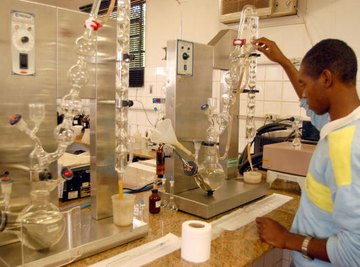
Distillation is a procedure where an experimenter separates a mixture of liquids based on their tendency to vaporize. Generally, each liquid vaporizes at a different temperature. A distillation column is utilized during fractional distillation, where the difference in boiling points between the liquids in the mixture is less than 50 degrees C. The column is made of glass and usually filled with glass beads or metal shavings. The beads and metal shavings improve separation by increasing surface area.

Instructions

    • 1

      Attach the distillation column securely to the adjacent materials. The column should be placed between the distilling flask and the connecting adapter. If the column is not attached properly, the setup will fail to be a closed system. This will allow air to enter the column and compromise the results.

    • 2

      Dry the distillation column thoroughly. There should be no condensation on the inside column. This will contaminate the sample in the closed system and result in inaccurate results. In general, the distillation column should not be washed. It is extremely difficult to dry.

    • 3

      Lower the flame on the Bunsen burner. The mixture in the distilling flask must be heated at a constant and steady rate. It is better to heat at a low flame so that each liquid in the mixture can vaporize and separate fully. If the mixture is heated too quickly, the liquids will not have the opportunity to vaporize and recondense properly. The distillation column will not be able to adequately separate the liquids.

    • 4

      Lift the thermometer out of the distillation column. The thermometer is placed into the connecting adapter to gauge the boiling point temperature of the vaporized liquids. The thermometer bulb must be located at the opening of the connecting adapter where it connects to the condenser. If the bulb is dropped too low and enters the distilling column, the column will fail to produce pure samples of the separated liquids.

    • 5

      Place the distillation column vertically. Some people slightly slant the column in the setup. This would still separate the liquids, but would result in lower percent recovery and poorer separation of the liquids.

Tips & Warnings

  • Cover the openings of the distillation column with a small amount of Vaseline. This will prevent the glass materials from sticking after distillation.

  • Keep the distillation column in a clean area. It is very difficult to get any small pieces out of the column if it gets contaminated.

Related Searches:

References

Comments

You May Also Like

  • How to Troubleshoot Distillation

    Distillation is a process of separating a mixture of liquids due to their volatility, or tendency to vaporize. As a mixture is...

  • Types of Fractionating Towers

    Types of Fractionating Towers. Distillation separates out the constitutes of a liquid solution -- such as the process that turns wine into...

  • Distillation Problems

    Distillation is the separation and purification of liquid substances utilizing differences in boiling point. Several distillation methods are utilized because ...

  • How to Size a Distillation Column

    Learn to size a distillation column to be sure you use the right equipment for your experiment. Distillation involves the heating of...

  • How to Improve Fractional Distillation

    Fractional distillation allows the separation of pure compounds from complex mixtures based on the components boiling point. Each compound evaporates up the...

  • How to Troubleshoot HPLC Columns

    The column of a high performance liquid chromatography (HPLC) machine is the stationary phase of the extraction process. The liquid--typically a buffer...

  • Distillation Procedures

    Distillation Procedures. Distillation is the process used to purify or separate different components of a mixture. It has many uses, aside from...

  • How to Assemble a Simple Distillation Apparatus

    Distillation is a separation technique that selectively separates a pure liquid substance from other compounds and impurities based on their boiling point....

  • How to Make a Distiller

    A commercial distiller is a highly complicated apparatus. But you and your child can make this simple solar water distiller with a...

  • Ethanol Distillation of Plants

    Ethanol distillation of plants is the process of taking the mixture of fermented ethanol and water from plants and using heat in...

  • Distillation Methods

    Distillation Methods. Distillation is a process that separates the constituents of a mixture. The process is used to fraction crude oil into...

  • Distillation Techniques

    Distillation is process of separating an organic liquid from water. This liquid may be alcohol, oils, waxes or other fats. Distillation is...

  • How to Make Liquid Nitrogen Through Distillation

    Liquid nitrogen is used in industrial and research applications. Providing the product to customers isn't difficult, as its availability is abundant. The...

  • The Types of Distillation Trays

    The Types of Distillation Trays. Distillation is one of the most widely used liquid separation techniques in the chemical industry. It typically...

  • What Is Molecular Distillation?

    Distillation is a purification and separation process that utilizes heat energy, which separates compounds according to a boiling point. Distilled vapors are...

  • How to Build a Home Steam Distillation System

    The process of steam distillation separates the components of a solution by boiling and condensing the substance in the solution at the...

  • Describe Simple Distillation

    Simple distillation is a process that separates liquids by evaporating them, capturing the vapors at different points in their cooling cycles and...

  • Why Is Fractional Distillation Useful?

    Fractional distillation makes it possible to extract individual liquids from a mixture of substances. It's what produces gasoline for cars and spirits...

  • Types of Trays in a Column

    Types of Trays in a Column. Distillation columns are thermal separation units. These centuries-old methods of separating a liquid or gas into...

Related Ads

Featured