
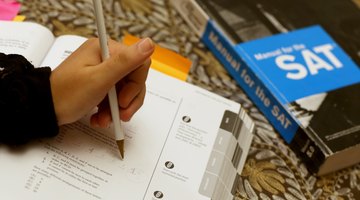


The SAT is a timed, standardized test that is designed to estimate how well students will do in the college setting. It does this by measuring vital skills like reading comprehension, fluency of writing and mastery of logic. The SAT is also used by both colleges and high schools to compare student populations based on academic performance.
Over the years, however, the test has undergone some important changes. Gone are the days when students had to complete complex analogies and memorize vocabulary words that they might never see again in real life. Those aspects of the test have been replaced, and the test has been redesigned to measure skills that will be useful in the real world. These skills include the ability to read and understand complex texts with multiple-meaning words, interpret charts and graphs, correct grammatical errors and perform multistep calculations based on realistic problems.
Tip
The entire SAT test, including the essay portion and breaks, is four hours and five minutes long.
How Long Does the SAT Take?
Now that you signed up for the SAT, you might be wondering, “How much time does the SAT test take?” The entire SAT test takes three hours. With one five-minute break and one 10-minute break, the total time for the SAT test without the optional essay portion comes to three hours and 15 minutes.
If you do choose to take the essay portion of the SAT, that will add 50 minutes to your testing time. In that case, the entire test, including breaks, will be four hours and five minutes long.
SAT Time Breakdown
Including the essay portion, the SAT includes four sections: the reading test, the writing and language test, the math test and the essay.
The reading test allows students 65 minutes to complete its 52 questions. That means students will have one minute and 15 seconds to answer each question in the reading section.
The writing and language test allots 35 minutes to answer 44 questions. That means students will have about 47 seconds to answer each question in the writing and language section.
The math test gives students a whopping 80 minutes to answer 58 questions. That means students will have about one minute and 13 seconds to answer each question in the math section.
Finally, though the essay test only has one question, students have 50 minutes to answer it completely.
When Are the Breaks in the SAT?
The SAT test with the essay portion allows students to take three scheduled SAT breaks. The first break comes after the reading test, and it is 10 minutes long. The second break comes in the middle of the math test after the “no calculator” section is finished. This break is only five minutes long. The last break comes before the essay portion and is only two minutes long.
What Can You Do on SAT Breaks?
During the first and second breaks, you are allowed to leave the room to use the bathroom, eat a snack or go stretch. Students leaving the room have to keep their IDs and admissions information with them the entire time they’re out of the testing room. Proctors will double check students’ IDs and admissions tickets when they re-enter the room.
Before leaving the room, students have to close their test booklets and leave the test booklets, their answer sheets and their calculators on their desk while they are out of the room. Students can’t use electronic devices, such as cellphones, during breaks or at any other time during the test. If a proctor catches a student with his cellphone, then that student’s test will be invalidated, meaning all the work he has done will not be scored.
For the last break before the essay test, students can get up from their desks to stretch, but they can’t leave the testing room.
SAT Test Day Tips
The night before your test, eat a good dinner, lay out your clothes for the next day and go to sleep early. On the day of your test, make sure you eat a balanced breakfast so you don't get hungry during the test. Before you leave, double check your bag so you have everything you need. Don't forget your official ID, and bring a printout of your testing information. Pack a snack and a drink for break time. Get to your testing site with time to spare, and then try to relax. Talk to friends if you know other people at the test site, or you can use your extra time to sit quietly and get in the zone.
Tips for Beating the Clock on the SAT
The timing of the SAT can seem daunting, especially on the writing and language test, where you have to answer each question in under a minute. However, with practice and by mastering a few strategies, you can tackle the fast pace of the SAT with ease.
One of the biggest mistakes you can make is trying to go too quickly. Don't speed through the questions or skim the reading sections. Take your time and read carefully. Don’t spend too much time on any one question. Skip questions you don’t know, and come back to them at the end of the section if you have extra time. If you still don’t know, then take a guess. The SAT no longer penalizes test takers for incorrect answers.
The best way to master the SAT’s pacing is to take timed practice tests. Give yourself the same amount of time you would have on the actual test to take the practice test. If you don’t make it all the way through the section, mark the questions that you spent the most time on and find practice samples for those questions. Closing those gaps in your knowledge will benefit your overall score later when you take the real SAT. Once even those questions become easy, you will be able to breeze through the test.
When Should I Take the SAT?
Plan to take the SAT before winter break of your junior year of high school. However, for some early decision college applications, you may need your scores sooner than that. In that case, sign up to take the SAT during the summer before your junior year. Taking it during the summer will give you time to relax and practice. The more stress-free you can make your test-taking experience, the better.
What Is on the SAT Reading Test?
The SAT reading test measures one of your most important academic skills: reading comprehension. Since you have been improving on this skill for most of your academic life, it is very difficult to cram in studying for this section beforehand. Luckily, though, you don’t need to memorize any vocabulary for this section either.
To practice for the SAT reading test, read widely from books and articles on many different topics, from fiction and the humanities to science. Whenever you encounter a word you do not know, write it down and look up the definition to learn its meaning. When you are studying, pay close attention to homophones, homonyms and other multiple-meaning words. The new design of the SAT places focus on everyday words, especially those that require context clues to understand. That is why close reading is key, not only to the reading section but to the writing and language section as well.
The reading section of the SAT test will also ask you to identify the part of a passage where you found the answer to the last question. Being able to locate and identify this evidence is a major skill being measured by this test. It will also help you on the writing and language section and on the essay.
The reading section is all multiple choice, and the questions are based on reading and interpreting passages of text or graphics. This section only tests your ability to read and understand. It will not ask you to remember other facts you have learned in class.
What Is on the SAT Writing and Language Test?
The SAT writing and language test assesses your grammar and writing skills without making you write a thing. It does this by asking you to locate errors and mistakes in passages and to find the best way to fix them. These are practical skills that you should already know, but if you want to study them, take extra time to learn proofreading and editing skills. Practice these skills by correcting your friends’ papers.
In this section, you will also have to pay attention to multiple-meaning words and use your evidence-gathering skills. However, you will not need any outside knowledge of the topics you will be reading. Additionally, all of the questions in this section will be multiple choice.
What Is on the SAT Math Test?
The SAT math test is all about realistic problem solving and logic. The way the test has been designed, the questions are meant to seem like life issues you might run into in college courses or on the job. These questions aren’t simple, though. Most of them will require you to perform several different steps in order to solve them.
There are three different types of questions on the math section: problem solving and analyzing data, algebra and advanced math. Geometry and trigonometry may also be included. Most of the questions in the section are multiple choice. There are also “grid-in” questions that require you to determine the exact answer and write in the numbers.
The math section of the SAT is split in half. In the first half, you will not be allowed to use a calculator. In the second half, you can.
What Is on the SAT Essay Test?
On the redesigned SAT essay test, not only will you be required to read and understand a passage, you will need to synthesize information from the ideas you have read. The most important knowledge you will need to bring into this, other than your fluent writing skills and your mastery of grammar and style, is a knowledge of persuasive rhetoric. The test will ask you to analyze the argument of a given passage. You will need to then respond using evidence in the form of quotations from the passage to support your answer. Essay scorers pay close attention to your reasoning, so make sure your logic is sound.
Try to write a standard five-paragraph essay, with a solid introduction and conclusion and three well-reasoned body paragraphs. If you do not have time to write five paragraphs, opt for a four-paragraph structure instead, with two body paragraphs instead of three. Leaving out the conclusion may hurt your score. You will have only 50 minutes to write the essay, so use them wisely.
Though this section is optional, you should plan to take it because not completing the essay portion of the SAT may limit your options when you’re applying to colleges.
Related Articles








References
Writer Bio
Rebecca Renner is a teacher and freelance writer from Daytona Beach, Florida. Her byline has appeared in the Washington Post, New York Magazine, Glamour and elsewhere.