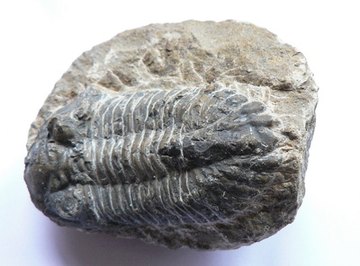
Fossils are remains of ancient life that are over 10,000 years old and have been preserved in the earth's crust--usually mineralized bones, teeth, or shells. If you are interested in fossil collecting, Arkansas is a perfect hunting ground. According to the Rockhounding Arkansas website, fossils are usually found in sedimentary rock and deposits; these materials, dating from the Late Precambriam Era to the Recent Era, underlie 99 percent of the state. Fossils commonly found in Arkansas include mollusks, corals, jellyfishes and trilobites; on occasion, dinosaur bones have been found. By becoming familiar with the locations of the four most fossil-rich areas in Arkansas, and refining your search for the types of fossils they contain, you can increase your chances of coming home with a piece of prehistory.
- Chisel
- Butter knife
- Old toothbrush
- Pry bar (optional)
- Notebook
- Aluminum foil
- Foam padding (optional)
- Small canvas bag (optional)
Work slowly and carefully as you are unearthing fossils; your find may be valuable.
To avoid risk of serious injury, use caution when climbing on bluffs or in quarries. Try to collect fossils in pairs or groups; if this is not possible, carry a cell phone, water, a sweater, and tell someone where you are going.
Wear comfortable shoes or hiking boots.
Search in the Ozark Plateaus, a shallow-water, marine-carbonate environment in which you can find invertebrate fossils including coral and mollusk remains and parts of trilobites--extinct marine arthropods. Start your search in the bluffs along steep hillsides, along road cuts, in headwater areas of drainage, and in rock quarries. Examine limestone outcrops and deposits of clay and sediment.
Search in the Arkansas River Valley, south of the Ozarks, which is floored by units of shale and sandstone, and where plant fossils--even ferns, in vertical positions as they were in life--can be found in sedimentary units overlying coal.
Hunt the West Gulf Coastal Plain, which covers most of south Arkansas, particularly Sevier, Little River, Howard, Pike, Hempstead, Nevada, and Clark counties; these are the most fossil-rich beds in the state. Look in road cuts, ditches, stream beds, and quarries containing outcroppings. You may find mollusk shells, as well as the remains of marine vertebrates such as shark, fish, turtles and crocodiles. There are also terrestrial fossil beds, which have yielded bones of dinosaurs, including those of the raptor and the hadrosaur. You may also find petrified wood.
Search in the Mississippi Embayment, also called the Mississippi Delta. Fossil sites are scarce, but may be very prolific when found. Fish vertebra, teeth from sharks and rays, shell remains, and even parts of primitive toothed whales have been recovered. In the northeastern section of the state, there have been finds of the remains of both mastodon and mammoth.
Start in areas where erosion has exposed sedimentary rock--look for rock that is stratified into different layers. Then, look for unusual shapes and textures--patterns that are obviously different from the rock around them.
Use a chisel to split pieces of shale in order to find trilobites. Although specific tools, such as pry bars, are available for fossil collectors, you can start your hobby with the chisel, a butter knife for unearthing potential fossils, and an old toothbrush to clean them off.
Examine creek beds to find rocks with fossil shell fragments, and look for boulders of soft, chalky sediment that you can break with your chisel in order to find extinct clams and mollusks.
Carry a notebook and record the location of your find, including the type of rock in which it was found.
Wrap your find in aluminum foil for ease of transport; depending how fragile it is, you may want to put it in a bag with padding.
If you find something that you think might be significant, notify archaeologists at your local university.
Things You'll Need
Tips
Warnings
References
Tips
- Work slowly and carefully as you are unearthing fossils; your find may be valuable.
Warnings
- To avoid risk of serious injury, use caution when climbing on bluffs or in quarries. Try to collect fossils in pairs or groups; if this is not possible, carry a cell phone, water, a sweater, and tell someone where you are going.
- Wear comfortable shoes or hiking boots.
About the Author
Carol Sarao is an entertainment and lifestyle writer whose articles have appeared in Atlantic City Weekly, The Women's Newspaper of Princeton, and New Millennium Writings. She has interviewed and reviewed many national recording acts, among them Everclear, Live, and Alice Cooper, and received her Master of Fine Arts degree in writing from Warren Wilson College.
Photo Credits
trilobite image by Alison Bowden from Fotolia.com