

Under certain conditions, permanent magnets are not always permanent. Permanent magnets can be made nonmagnetic through simple physical actions. For example, a strong external magnetic field can disrupt a permanent magnet's ability to attract metals like nickel, iron and steel. Temperature, like an external magnetic field, can also affect a permanent magnet. Although the methods differ, the results are the same — like a too high external magnetic field, a too-high temperature can demagnetize a permanent magnet.
Magnet Domain Basics
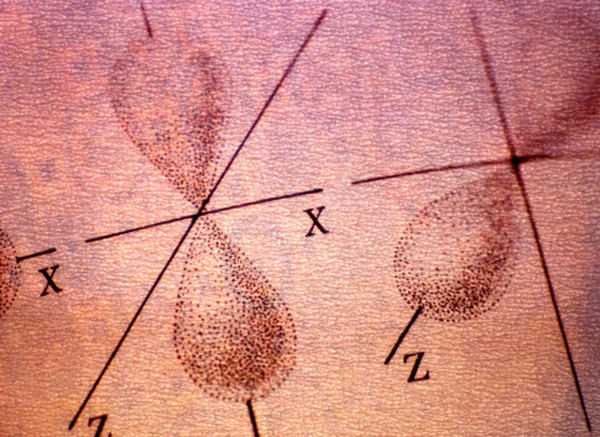
The power behind a magnet to attract metals lies within its basic atomic structure. Magnets consist of atoms that are surrounded by orbiting electrons. Some of these electrons spin and create a tiny magnetic field called a "dipole." This dipole is very similar to a tiny bar magnet that has a north and south end. Within a magnet, these dipoles combine into larger and more magnetically powerful groups called "domains." Domains are like magnetic bricks that give a magnet its strength. If the domains are aligned with each other, the magnet is strong. If the domains are not aligned, but arranged randomly, the magnet is weak. When you demagnetize a magnet with a strong external magnetic field, you are actually forcing the domains to go from an aligned orientation to a random orientation. Demagnetizing a magnet is weakening or destroying a magnet.
Magnetic Field Effects
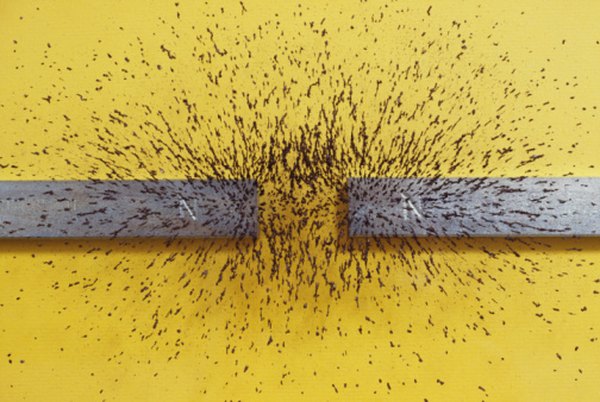
Strong magnets — or electric devices that produce strong magnetic fields — can affect magnets that have weak magnetic fields. The pull of a strong magnetic field can overpower the domains of a weaker magnet and cause the domains to go from an aligned orientation to a random orientation. This is especially true when a weak magnet's magnetic field is oriented perpendicular to a stronger magnet's magnetic field.
Temperature Effects
Temperature, like a strong external magnetic field, can cause a magnet's domains to lose their orientation. When a permanent magnet is heated, the atoms in the magnet vibrate. The more the magnet is heated, the more the atoms vibrate. At some point the vibration of the atoms causes the domains go from an aligned, ordered pattern to a nonaligned disordered pattern. The point where excessive heat reaches a temperature that causes the atoms to vibrate and rearrange a magnet's domains is called the "Curie Point" or "Curie Temperature."
Curie Points
Because magnetic metals have differing atomic structures, they all have different Currie Points. Iron, nickel and cobalt have Curie Points of 1,418, 676 and 2,050 degrees Fahrenheit respectively. The temperatures below a Curie Point are referred to as a magnet's magnetic ordering temperature. Below the Curie Point, the dipoles rearrange themselves from a disordered, nonparallel orientation into an ordered aligned orientation. However, if a heated permanent magnet is allowed to cool while oriented parallel with a strong external magnetic field, the permanent magnet is more likely to successfully return to its original or stronger magnetic state.
References
- Magnet Lab, National High Magnetic Field Laboratory: Magnetic Domains
- "The World Book Encyclopedia"; Magnet; 2009
About the Author
Since 1999, Timothy Boyer has worked as a freelance writer. His career began as a science columnist with "The Northwest Explorer" and as a science writer with McGraw-Hill publishing's Power Web Series of educational articles. Boyer has a Ph.D. in molecular and cellular biology from the University of Arizona.
Photo Credits
Paul Tearle/Stockbyte/Getty Images