
How to Set the Wheel Size in a Bike Computer
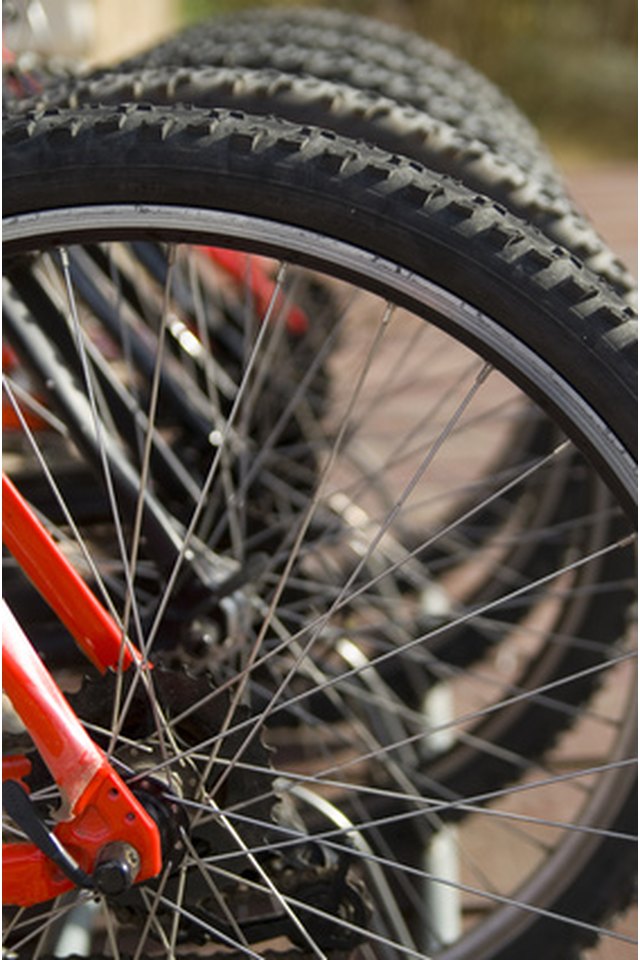
Generally, you can look to your tire's sidewall to locate its size, match this number--usually something like 700 X 23 or 26 X 2.0--to a code in your bike computer's owner's manual and follow these instructions to enter the code into the computer. The computer needs to know the tire size so that it can accurately translate tire revolutions into ride statistics, such as mph or kph and distance traveled. In some cases, you might not have complete data or you desire near-perfect accuracy. Use the roll-out method for calibrating your computer in these situations.
Place a small spot of paint on the center of your bicycle's front tire.
Move the bicycle forward so that the tire makes two paint marks on the pavement. As the late bicycling expert Sheldon Brown notes, for accuracy's sake, you must keep the wheel perfectly straight when moving forward. Use an assistant to steady and guide the bike, while you, sitting on the bike, hold the handlebar straight.
Measure the distance between the two paint marks the tire makes on the road with a tape measure. For greater accuracy, Brown advises moving the bike three to four revolutions and using the average distance between all revolutions.
Calculate your result by 2.54 to get centimeters and 25.4 to get millimeters if your tape measure uses inches. Some bike computers require you to input tire size in centimeters, while others use millimeters. If your computer asks for radius, divide your result by 6.2832 to obtain that value.
Tips
Brown contends it is important to ride aboard the bike when executing the roll-out method to simulate riding conditions. Use the proper tire pressure--listed on your tire's sidewall--as well. This ensures that the revolution statistics you get when testing are as close as possible to what occurs when riding "for real."
The actual act of inputting values in bike computers varies by computer. The roll-out method is universal.
References
Tips
- Brown contends it is important to ride aboard the bike when executing the roll-out method to simulate riding conditions. Use the proper tire pressure--listed on your tire's sidewall--as well. This ensures that the revolution statistics you get when testing are as close as possible to what occurs when riding "for real."
- The actual act of inputting values in bike computers varies by computer. The roll-out method is universal.
Writer Bio
As a writer since 2002, Rocco Pendola has published numerous academic and popular articles in addition to working as a freelance grant writer and researcher. His work has appeared on SFGate and Planetizen and in the journals "Environment & Behavior" and "Health and Place." Pendola has a Bachelor of Arts in urban studies from San Francisco State University.