

How to Remove a Septic Tank

Your septic tank has failed, or new construction plans call for it to be relocated. Whatever the reason, the tank must be removed and either relocated or removed. This can be a somewhat physical task and will involve several steps.
Things You Will Need
- Shovel
- Small marker flags (4 to 8)
- Backhoe
- Hacksaw
- Pipe caps (2)
- Barricades (optional)
- Log chains
- Fill material (if septic tank is not being replaced)
-
Locate the septic tank. Most new tanks will have access or inspection ports at the surface, making this task very simple. If it is an older tank, this task may be a little harder. Locate the main drain line as it exits the house and draw an imaginary line out approximately 15 feet. This should be directly over the tank. Dig a test hole verify the location. When the tank is located, mark its position using the small marker flags.
-
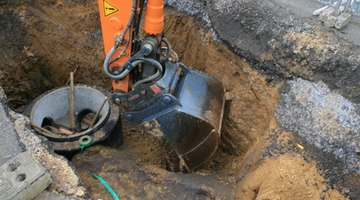
Dig down to the septic tank using the backhoe. Uncover the complete top of the tank which should include the access hatch. Halt the excavation and have the tank pumped out by a licensed professional who will have the equipment as well as the license to dispose of the waste materials legally.
-
Dig out on all four sides of the tank. Digging out the width of the backhoe bucket will be fine. The hole must be excavated deep enough to reach the bottom of the septic tank. The backhoe operator will need to be very cautious when digging around the inlet and outlet pipes to avoid breakage.
-
Cut both pipes well away from the septic tank. Immediately cap each of these lines to prevent any water or waste remaining in the lines from draining into the hole where you will be working. Remove the two sections of pipe from the septic tank and discard them.
-
Feed the log chains through the inlet hole in the tank and guide it out the outlet port. Bring the chains up over the septic tank and secure them to the backhoe bucket or crane if available. Once the chains are secure, move safely away and allow the backhoe to lift the tank clear of the hole.
-
Backfill the hole or replace the septic tank as quickly as possible after the tank is removed. If the hole will be left open for a time, be certain to barricade the perimeter of the hole to prevent anyone from accidentally falling in.

The Drip Cap
- Your septic tank has failed, or new construction plans call for it to be relocated.
- This can be a somewhat physical task and will involve several steps.
- Cut both pipes well away from the septic tank.
- Once the chains are secure, move safely away and allow the backhoe to lift the tank clear of the hole.
Writer Bio
Tom Raley is a freelance writer living in central Arkansas. He has been writing for more than 20 years and his short stories and articles have appeared in more than 25 different publications including P.I. Magazine, Pulsar and Writer's Digest.
Photo Credits
- Excavation image by Claude Wangen from Fotolia.com
- Excavation image by Claude Wangen from Fotolia.com
- water tanker truck image by Francois du Plessis from Fotolia.com
More Articles

