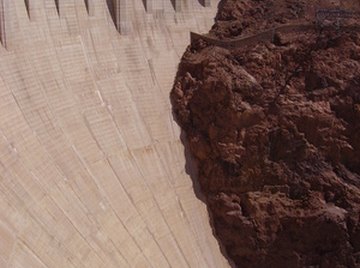

Dams are used to divert or hold back water from rivers and other waterways. While humans construct them to generate electricity, create reservoirs for drinking water and prevent flooding, in the wild, beavers build dams to create deep bodies of water that attract food and provide safety from land-based predators. For a science project, try replicating the technologies used in both types of water dams.
Hydroelectric Power
Hydroelectric plants—which are constructed at the base of dams—use the weight or pressure of the flowing water to spin turbine blades. The water is channeled through a device called a penstock, which focuses various streams onto the blades. According to energyquest.ca.gov, you can imitate this process using an empty half-gallon milk carton, some water, masking tape, a nail, a ruler and a marker. Using the nail, poke a hole in the milk carton a half-inch up from the base, and then make holes the same size at the one-, two- and four-inch marks. Cover all the holes with a single piece of tape and fill the carton up with water to a line (which will remain constant) that you designate with the marker. Then pull off the tape and observe which hole produces the strongest, farthest-flowing stream; according to energyquest, this will always be the hole closest to the bottom, as the added weight of the water above it generates more pressure.
Beaver Dam
Beavers use simple techniques to construct their dams, piling up trees, sticks and other natural debris to form a barrier. As a science project, exploring these building techniques is thus best suited to younger, elementary-level students. According to teachersdomain.org, you will need to have access to a hose, a backyard (preferably an area without grass or other vegetation that could be harmed) and various natural materials, like sticks, leaves, stones and moss. Run the hose in a fixed position until there is a constant flow of water or mini-river on the ground. Then try out different materials, both individually and in combinations, to determine which configuration works the best for diverting the water. Try imitating the beaver’s technique by interweaving sticks, then plugging the gaps with other debris.
Tidal Dam
This project relies on the same forces as the hydroelectric-power project. However, instead of imitating a standard river dam, this project is designed to replicate a tidal dam, or barrage, which also generates hydroelectric power. According to sciencebuddies.org, when the tide comes in, the water flows through tunnels and is pumped through turbines, which spin, creating electricity. To replicate this process, drill three different-size holes—one that is half an inch, one that’s an inch, and one that’s two inches in diameter—in the bottom of a plastic bucket (these are your tunnels). Plug each hole with an appropriate-size rubber stopper, and fill the bucket with water. Now you are ready to test the power generated by each “tunnel,” which you unleash by pulling out the plugs one at a time (of course, you need to refill the bucket after each test). To calculate the power output, connect a plastic propeller (such as one on a toy boat) to the end of a brass rod, and hold it in the bucket during each test. Count how many rotations the propeller makes when each hole is unplugged.
References
About the Author
Erik Devaney is a writing professional specializing in health and science topics. His work has been featured on various websites. Devaney attended McGill University, where he earned a Bachelor of Arts in humanistic studies.
Photo Credits
the hoover dam image by Darren White from Fotolia.com