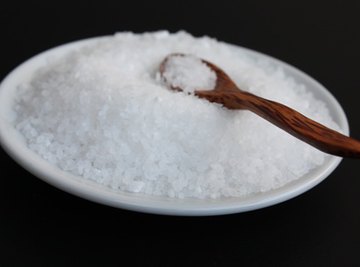

The purity of a salt compound refers to the percentage of each salt element in the final crystal product. Sodium (Na) chloride (Cl) or common salt, is often manufactured using evaporation to produce the crystals. Rock salt and solar salt are naturally produced compounds of a high grade of purity even before refining takes place. Rock salt typically results from underground halite deposits. Solar salt is produced from the effect of the sun and wind on seawater or freshwater brine ponds. In common salt, the moles of each compound are at a 1 to 1 ratio. Purity of a common salt compound can be determined with knowledge of the molar mass of the sample, the molar mass of each element and the standard values of percent composition of salt at it's purest.
- Sodium chloride, NaCl
- Calculator
- Periodic table
Calculate the percent composition of sodium and chlorine in the sample using the molar mass of sodium chloride. Molar mass is the weight in grams of one mole of an element. This information can be found on a periodic table listed as the elements "atomic weight." Each element has 1 mole in a given molecule of NaCl, so the total molar mass of the compound is found by simply adding the molar masses of the individual components together.
Look up the individual molar mass for sodium by finding its atomic weight on a periodic table. The atomic weight of sodium is 22.989 grams, so its molar mass is expressed as 22.989 grams/mole. Find the molar mass of chloride using the same method. The atomic weight of chlorine is 35.453 grams with a molar mass expressed as 35.453 grams/mole.
Add together the molar masses of sodium, 22.989 g/mol, and chlorine, 35.453 g/mol. The total value should equal 58.442 g/mol, which is the total mass of the salt compound.
Divide the individual mass of sodium, 22.989 g/mol, by the total mass of the compound, 58.442 g/mol. Multiply this value by 100. The result is the percent composition of sodium in the compound, 39.336 percent. Repeat these steps to get the percent composition of chlorine, 60.664 percent.
Compare the percent values of each element in your sample with the standard values you've just calculated. Determine the purity of the sample by dividing the percentage of your standard values by the listed values in your compound. Multiply this value by 100 to get the percent purity of your compound.
Things You'll Need
About the Author
Matt Badger has been writing professionally since 2010, contributing to various websites. Badger has a Bachelor of Science in biology from the University of Washington.
Photo Credits
Salt image by lefebvre_jonathan from Fotolia.com