Specific gravity is a dimensionless unit that defines the ratio between the density of a rock and the density of water at, typically, 4 Celsius. Density is an important characteristic of a rock, since this parameter helps to identify the rock type and its geologic structure. To calculate the rock density you need to divide the mass of the rock by its volume. The latter can be determined by placing the rock into a graduated cylinder filled with water.
- Scale
- Graduated cylinder
- Calculator
Select a rock sample with an approximate weight of 20 to 30 g.
Weigh the rock on the scale; for example, the rock mass is 20.4 g.
Fill the graduated cylinder approximately half full with water. Then determine the exact water volume using the cylinder scale. For example, you may put 55 ml of water in the cylinder.
Put the rock into the graduated cylinder making sure that your sample is completely covered with water. Note that the water level will rise.
Determine the volume of the water in the graduated cylinder again; for example, the volume after placing the rock is 63 ml.
Subtract the initial volume (Step 3) from the final volume in the cylinder (Step 5) to calculate the volume of the rock. In our example, the rock volume is 63 - 55 or 8 ml.
Divide the mass of the rock by its volume to calculate the density of the rock. In our example, the density is 20.4/8 = 2.55 g/cubic cm.
Divide the rock density by the density of water to calculate the specific gravity. Since the water density is 1 g/cubic cm (at 4 Celsius) then the specific gravity in our example will be 2.55 g/cubic cm / 1 g/cubic cm or 2.55.
Things You'll Need
References
About the Author
This article was written by the CareerTrend team, copy edited and fact checked through a multi-point auditing system, in efforts to ensure our readers only receive the best information. To submit your questions or ideas, or to simply learn more about CareerTrend, contact us [here](http://careertrend.com/about-us).
Photo Credits
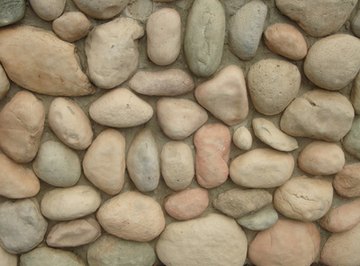
rock wall image by Jackie DeBusk from Fotolia.com