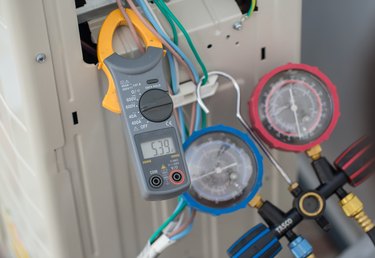
Capacitors are not just used in the HVAC industry; they are also used for electronics and many things that require motors, even microwaves. This technology was invented in 1746 in Holland, and one famous use of this technology from that era was Ben Franklin's kite-flying experiment in 1752.
Capacitors are one the most commonly replaced items in an HVAC system. These capacitors store energy to give motors the boost they need to start up, which is called an electric motor start capacitor. Another kind of capacitor that gives a little extra energy to keep the motor running efficiently is the electric motor run capacitor. Both types of capacitors do this by storing energy, which is released similarly to how static electricity might give you a little jolt on a dry winter day. Testing a capacitor with an ohmmeter is relatively simple, but it does require some extra electrical safety to keep from getting a shock from the stored energy.
Video of the Day
Video of the Day
Symptoms of a Bad Run Capacitor
A slow-moving motor is a dead giveaway to a bad electric motor run capacitor. If your air conditioner fan motor feels like it just isn't doing what it used to or isn't moving at all, then this might be a sign of a weak or bad capacitor. This is due to the electric motor's run capacitor not providing assistance to the motor, and now the motor does not have enough "oomph" to run.
One quick way to check the capacitor is to shut off the power to the appliance, take a look around, and find the capacitors. Many times, a bad capacitor will show signs of bulging or leaking. This is a firm indication that the capacitor is bad and needs replacement. Do not operate the appliance until the capacitor is replaced with an exact match.
Symptoms of a Bad Start Capacitor
Electric motor start capacitors are not simple to diagnose except checking the capacitor for bulging or leakage. These capacitors also give the "oomph" to get a motor running, but these capacitors are typically used on compressors for both air and central air conditioning systems as well as any motor that needs a lot of extra kick to get things started. The extra power is sent to a specific set of windings in the motor that get the motor up to speed, and these windings are typically disengaged once the motor has gotten up to speed. If the electric motor start capacitor is bad, the motor will overheat while trying to start up.
If you hear the compressor contactor make contact (a distinct "click" noise from the control box and the outdoor fan will hopefully start) and the pipes do not get cold, you probably have a bad start capacitor, or there is something wrong with the compressor. Digging into diagnosis beyond this might take a little more than the average home DIY technician should safely address. Some things might be better left to the professionals.
Check a Capacitor With an Ohm Meter
Now that you have determined that a capacitor is possibly bad, you may want to confirm your diagnosis. This can best be done with a capacitor tester or a multimeter that is capable of capacitance measurement. If you have a basic ohm meter, you can check a capacitor; however, it will not tell you if it is weak. It will only tell you if it is capable of storing energy.
- Disconnect or unplug all electrical power to the appliance.
- Set the ohm meter to the highest ohms.
- Discharge the capacitor by shorting out the terminals with a capacitor discharging tool.
- Remove any wire connections that may be on the capacitor terminals.
- Place the test probes on the capacitor terminals.
Reading the Ohm Meter
With the test probes on the capacitor, watching the meter and understanding the readings are important. The meter should immediately go to zero ohms, and then gradually, the ohms will grow. This is an indication of a good capacitor. If the ohms do not increase or if they decrease, then the capacitor needs to be replaced. Make sure to read the label of the capacitor and get exactly the same capacitor. Do not substitute; bigger is not always better when it comes to capacitance.