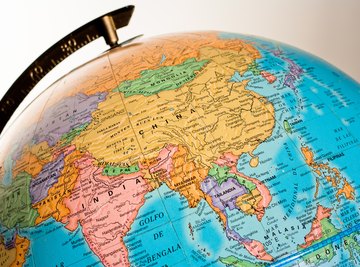

In the third century B.C., Eratosthenes, a Greek mathematician, became the first person to mathematically calculate the diameter of the earth by comparing differences in the angle of the sun’s rays at two separate geographic points. He noticed that the difference in the angle of a shadow in his location at Syene, which is present-day Aswan in Egypt, and that of a shadow in Alexandria was about 7.2 degrees. Since he knew the distance between the locations, he was able to determine the circumference of the earth, and therefore the diameter and radius as well. You can do this, too, by using his method.
TL;DR (Too Long; Didn't Read)
Using the curvature of the Earth relative to the parallel light from the sun, we can observe shadows at different locations on the surface of the Earth to find the Earth’s radius.
Record the Distance
Record the distance between your location and your partner’s location. As an example, we will use Eratosthenes measurements. The distance between Syene and Alexandria is 787 kilometers, Eratosthenes used the ancient Greek measurement of stadia, but his calculations use the proportionality of angles between two locations, so any system of measurement will work.
Take Measurements
Drive one of the meter sticks into the ground in your location in a sunny spot. Tack one end of a piece of string to the top of the stick. Have your partner do the same in her location. Make sure both sticks are perpendicular to the Earth and that the same length of stick protrudes from the ground.
Measure the Angle
Measure the angle of the shadow of your meter stick when the sun is overhead and the shadow is smallest, often known as local noon (when the sun is exactly north-south in the sky – at its highest point). Place the loose end of the string at the end of the cast shadow and hold it taut. Use the protractor to measure the angle where the string meets the stick at the top. Have your partner do the same in her location at the exact same time. Record the measurements.
Tips
Your partner should measure at the same time, regardless of time difference. So if you measure at 11:00am in New York, they should measure at 9:00am in Colorado because of the time difference.
Doing the Math
Subtract the angle measurements to determine the difference in the angle of shadows between the two locations. For Eratosthenes, at midday on the summer solstice where the sun’s angle was directly overhead, the angle was zero. Though he did not have instant communications as we do now, he was able to determine the angle of the sun’s rays in Alexandria at the same time, which was about 7.2 degrees. Therefore, the difference was 7.2 degrees.
Compute the circumference of the Earth using the distance and angle measurements you have. Since the locations are points on a circle that goes around the Earth, the distance between them can be expressed as an arc measurement on a 360-degree circle. For Eratosthenes, the arc was 7.2 degrees. The distance between locations are also part of the total circumference of the Earth. In Eratosthenes’ case, the distance was 787 kilometers, so for him, the following relation applied:
where x = the circumference of the Earth in kilometers. Solving for x reveals the circumference to be
- Partner in a distant location on about the same longitude or in the same time zone
- Mobile phone
- 2 poles 1 meter long
- Measuring tape
- 2 strings at least 1.5 meters long
- 2 tacks
- 2 protractors
- Calculator
Use a scientific calculator. Since pi is an infinite number, the calculations in Step 6 will be more accurate.
You must measure the angle of shadows in the two locations at the exact same time on the exact same day or the calculations will be erroneous.
Compute the radius of the Earth using the formula C (circumference) = 2 x pi x r (radius). Eratosthenes’ methods result in a formula that would look like this: 39,350 = 2 x 3.14 x r, or 6,267 kilometers.
Things You'll Need
Tips
What Error Might Impact
Because these measurements are not done with more sensitive equipment, the radius calculation will be only approximate. The equatorial radius of Earth is actually 6,378.1 kilometers. This measurement also introduces another fun source of error that actually comes from the motion of Earth and other similar planetary bodies in the solar system. Because of the Earth’s rapid rotation, it ‘stretches’ out the planet; this results in the South pole and North pole actually being slight closer than locations opposite on the equator because the shape of the Earth is not a spheroid (not a perfect sphere). As a consequence of this, the polar radius is closer to 6,356.7 kilometers.
Surveyors today use a variety of instruments and calculations to determine the size of the Earth and collect other relevant data. In the modern age, satellites often provide the most accurate and current information through global imaging. Technology similar to the instruments that are used to survey Earth can also be found all across the solar system. The recent Juno mission launched with the goal of examining Jupiter’s composition and underlying structure, the wikipedia article on the Juno spacecraft provides an a great overview of this type of process.
References
Tips
- Use a scientific calculator. Since pi is an infinite number, the calculations in Step 6 will be more accurate.
- You must measure the angle of shadows in the two locations at the exact same time on the exact same day or the calculations will be erroneous.
Warnings
- Because these measurements are not done with more sensitive equipment, the radius calculation will be only approximate. The actual radius of the earth is 6,378.1 kilometers at the equator, but the radius varies because the earth is a somewhat flattened sphere. The radius is more like 6,371 kilometers at the north and south poles.
About the Author
Karren Doll Tolliver holds a Bachelor of English from Mississippi University for Women and a CELTA teaching certificate from Akcent Language School in Prague. Also a photographer, she records adventures by camera, combining photos with journals in her blogs. Her latest book, "A Travel for Taste: Germany," was published in 2015.