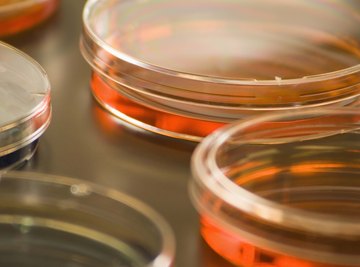

Petri dishes are a common item found in both professional and educational science labs. Unfortunately, budget restrictions force companies and educational establishments, such as high school and college biology labs, to reuse the Petri dishes. The disadvantage of reusing Petri dishes is the increased ability to contaminate your current experiment's culture with remnants from the previous experiment. However, there are various sterilization methods available depending on if your Petri dishes are glass of plastic.
Sterilizing Glass Petri Dishes
Turn on and preheat the electric hot-air sterilizing oven to 160 degrees C.
Using a soft, non-abrasive cloth, antibacterial dish soap and warm water, gently clean and rinse the Petri dishes. The Petri dishes should be free of all debris.
Dry the Petri dishes with a soft, non-abrasive dry cloth. Set aside.
Place the Petri dishes in the sterilizing oven, face up. Set the timer for two hours.
After two hours, turn the oven off and allow the oven to cool prior to removing the glass Petri dishes.
Remove the Petri dishes from the oven using sterile lab tongs. Do not allow your fingers or any unsterile material to touch the sterilized Petri dishes.
Store the sterilized Petri dishes in a sterile area until next use.
Sterilizing Plastic Petri Dishes
- Petri dishes (glass or plastic)
- Hot-air sterilizing oven
- Sterile lab tongs
- Clorox
- Water
- (2) Medium-size bowls
- (2) Sterile lab tongs (if using plastic Petri dishes)
- (2) Soft, non-abrasive dish cloths
- Rubbing alcohol
If you are sterilizing in your home, you can use your convection oven and a cookie sheet to sanitize the Petri dishes, instead of an electric hot-air oven.
Sterilizing glass Petri dishes depends on the temperature of the oven. It is recommended to place the oven at 160 degrees C for one to two hours, or 180 degrees C for 20 minutes.
If your experiment requires a 100 percent pure culture and you’re using plastic Petri dishes, then its best use new dishes sterilized from the manufacturer.
Do not reuse plastic Petri dishes if your experiment involves the use of live pathogens. The risk of cross-contamination is too great.
Mix 1/2 cup of Clorox (any 10 percent bleach solution will work) with 4 1/2 cups of warm tap water. You can mix more or less of the sterilization solution by remembering it one part bleach to nine parts water. Set the mixture aside.
Using a soft, non-abrasive cloth, antibacterial dish soap and warm water, gently clean and rinse the plastic Petri dishes. The Petri dishes should be free of all debris, including any soap residue.
Place the Petri dishes into the sterile bleach solution, one at a time, for approximately two minutes each.
Using sterile lab tongs, remove the Petri dish from the solution. Allow it to air drip for a few seconds; place it in a bowl of rubbing alcohol.
Immediately remove the Petri dish from the rubbing alcohol with another pair of sterile lab tongs and place it on a sanitary surface to air dry.
Store the sterilized Petri dishes in a sterile area until next use.
Things You'll Need
Tips
Warnings
References
About the Author
Travis Wampler began his writing career along America's forgotten highway, Route 66. His research received awards from the Association of American Geographers. Wampler has written comprehensive plans and grants for city planning departments and agencies. He holds a Bachelor of Science in geography from Southwest Missouri State University and a master's degree in information systems from the University of Phoenix.
Photo Credits
Jupiterimages/Comstock/Getty Images