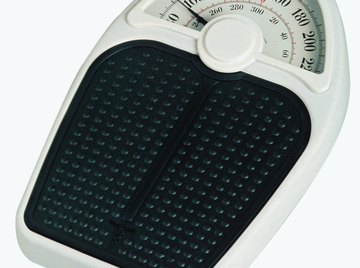
The standard error of the mean, also known as the standard deviation of the mean, helps to determine the differences between more than one sample of information. The calculation accounts for variations that may be present in the data. For example, if you take the weight of multiple samples of men, the measurements can range substantially in each sample; some may weigh 150 pounds while others, 300 pounds. However, the mean of these samples will vary by just a few pounds. The standard error of the mean illustrates how much the different weights vary from the mean.
Keep the sets of numbers clearly labeled. If you have to determine the standard deviation of the original distribution on your own, you will be working with two sets of numbers; the original set, and the set you figure out once you subtract the mean from each one. Confusing the two sets of numbers will lead to errors.
Write the formula σM =σ/√N to determine the standard error of the mean. In this formula, σM stands for the standard error of the mean, the number that you are looking for, σ stands for the standard deviation of the original distribution and √N is the square of the sample size.
Determine the standard deviation of the original distribution. The standard deviation simply tells us how far apart the numbers are on the number line. The information may be provided to you if you are working out a statistics problem. If so, replace the σ in your formula with the standard deviation. If it is not provided, you will have to find it on your own.
Find the mean of your set of numbers if the standard deviation is not provided; that is, add all the numbers together, then divide that sum by the number of items you added. Subtract the mean from each of your original numbers, and square the results of each. Determine the average of this new set of numbers you worked out; the answer will give you the variance. Square the variance to find the standard deviation. Plug the number in for the σ symbol in your formula.
Determine the sample size. The sample size is the number of items or observations that you are working with. Replace the N in the formula with your sample size.
Find the square root of the sample size with your calculator.
Divide the standard deviation by the square root of the sample size. The answer will give you the standard error of the mean.
Tips
References
Tips
- Keep the sets of numbers clearly labeled. If you have to determine the standard deviation of the original distribution on your own, you will be working with two sets of numbers; the original set, and the set you figure out once you subtract the mean from each one. Confusing the two sets of numbers will lead to errors.
About the Author
A resident of Riverside, California, Timothy Peckinpaugh began writing in 2006 for U.S. History Publishers, based in Temecula, California. He graduated magna cum laude from the University of California, Riverside, with a bachelor's degree in English.
Photo Credits
Comstock/Comstock/Getty Images