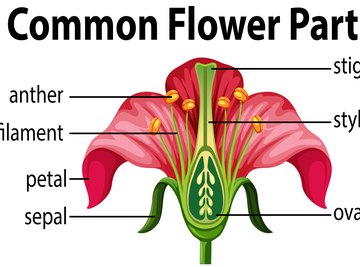
In addition to being beautiful, flowers have the important job of creating seeds. Just about all fruits and vegetables come from seeds. For instance, peach trees bloom in spring with flowers. Those blooms eventually turn into peaches. Look closely at a peach blossom, and you can see the various parts of a flower.
Main Parts of a Flower
Examine a flower diagram, and you’ll see that flowers consist of several parts. All these flower parts each have a specific function that allows the flower to bloom and then eventually become fruit or seed.
Petal
Petals are the pretty part of the flower that gives it its shape and form. Petals come in a wide variety of colors. These may include:
- white
- yellow
- pink
- red
- purple
- orange
- many others
Petals do the job of attracting pollinating insects and creatures to the flowers. These include bees, butterflies, birds and bats. Such creatures aid in fertilization.
Sepal
The sepal consists of small leaves growing at the base of the petals. They protect the flowers before they bloom. The sepals also help hold the flowers in place on the plants.
Peduncle
The peduncle is the flower stalk. The flower is located at the top of the peduncle. The peduncle is also known as the stem. This is the part of the plant that's trimmed to produce cut flowers.
Receptacle
The receptacle is the thickened section at the bottom of the flower that holds its organs.
Flower Pistil
Pistil: The female part of the flower, the pistil is located at the center of the bloom. The pistil contains the stigma, style and ovary. You’ll recognize the pistil in a plant diagram because it looks like a small knob that protrudes from the flower.
Stigma: The stigma is located at the tip of the pistil. This is the part of the flower that's sticky and collects pollen. The pollen initiates fertilization so that seeds can be created.
Style: The style is the long stalk that supports the stigma.
Ovary: Of all the parts of a flower, this is one of the most important. The ovary is located at the base of the flower. It has seeds inside known as ovules. These ovules are what turn into fruit.
Stamen
The stamen is the male part of a flower. In a flower diagram, stamen are located on both sides of the pistil. The stamen consists of two parts:
Anther: The anther is the head of the stamen. It produces pollen.
Filament: The filament is the stalk attached to the flower that holds the anther.
The stamen's function is to produce male reproductive cells. When pollinating insects, such as bees and butterflies, go to the flower for pollen, they also visit the stigma. This will fertilize the flower. When pollen gets to the stigma, a tube grows down the style. This tube enters the ovary. The male reproductive cells from the anther travel through the tube and join the ovule, fertilizing it.
Types of Flowers for Reproduction
As mentioned, many flowers have both male (stamen) and female (pistil) parts. This enables a flower to create seeds and fruit all on its own that can then be pollinated with the help of insects, birds or other creatures. Flowers that have a pistil and stamen and can reproduce on their own are known as perfect flowers.
Other types of flowers only have male or female organs. With these types of flowers, another flower of the opposite sex is needed to produce seeds and fruit. Such flowers are known as imperfect flowers.
References
About the Author
Julie Bawden-Davis is an accomplished writer, who specializes in home and garden. Since 1985, she’s written for a wide variety of publications, including “Organic Gardening,” "Better Homes and Gardens," "Ladies' Home Journal," "Parents," "Family Circle" and "The Los Angeles Times." Her books include "Fairy Gardening" and "Reader's Digest Flower Gardening." Bawden-Davis holds a Bachelor of Arts in journalism and is a certified master gardener.