
Muscle Groups Used When Using Gymnastic Rings
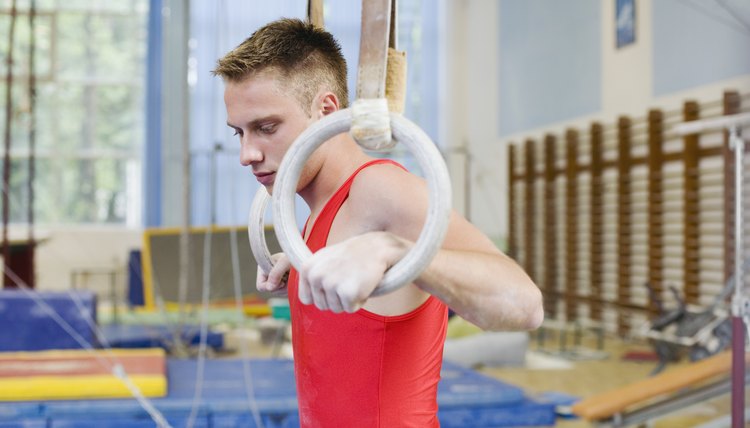
Gymnastics rings, once used primarily in sport competition, are becoming an increasingly popular piece of home exercise equipment. They not only allow for a variety of challenging exercises, but are also convenient to use and easy to store. Gymnastics ring exercises are more difficult to perform because they require the opposing muscles to work just as hard as the active muscles in a three-dimensional plane. While gymnastics rings are effective for total-body conditioning, the muscle groups of the upper body are primarily used.
Shoulder Muscles
Your shoulders are made up of your deltoids, your rotator cuff and a couple of larger muscles that cross the shoulder joint. The thick, multipennate deltoid muscles form the rounded muscle mass that make up the shoulders. Movement of the arms in any direction is accomplished by the deltoids. The smaller rotator cuff muscles work to rotate the humerus and stabilize your shoulder joint. Because gymnastics ring exercises revolve primarily around movement of the body via the arms, your shoulder muscles are constantly being used.
Arm Muscles
Gymnastics ring exercises are performed by holding onto the rings with your hands and manipulating your arms and body around the rings, thereby making these exercises an effective way to develop your arm muscles. Your triceps and forearm muscles are heavily used on the rings. The triceps are the large, fleshy muscles located on the back of your upper arms. These muscles are powerful arm extensors, used extensively for ring exercises such as the muscle up. The forearm muscles are divided into two groups: those causing wrist movements and those moving the fingers and thumb, all of which are important when using gymnastics rings.
Back Muscles
Nearly every muscle in your back is used on gymnastics rings. The large latissimus dorsi muscle is the prime mover of arm extension and is a powerful arm adductor. When reaching for the rings overhead, this muscle is used to pull the rest of your body upward and forward. The trapezius, levator scapulae and rhomboids all work together to stabilize and move your shoulder blades. The deep lying erector spinae muscles run along the length of your spine, providing stability and resistance that help control forward bending and act as powerful extensors to return your torso to an erect position.
Abdominal Muscles
The abdominal muscles can be specifically targeted with gymnastics ring exercises but are also essential for stabilizing your trunk and hips in nearly every other exercise. This muscle group is composed of the rectus abdominis, transverse abdominis, internal oblique and external oblique. Because this part of your body has no bony reinforcements, it relies entirely on these muscles to provide support and protection. Regular gymnastics ring training will help you develop a strong abdomen.
Writer Bio
Jen Weir writes for several websites, specializing in the health and fitness field. She holds a Bachelor of Science in exercise science from Montana State University, is an NSCA-certified strength and conditioning specialist and maintains a personal trainer certification from the American College of Sports Medicine.