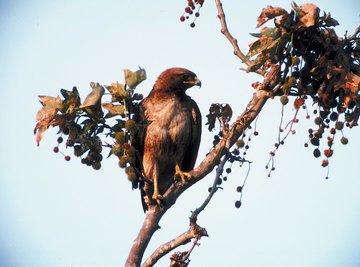
A hawk is a diurnal bird of prey that lives in primarily woodlands, grasslands, pastures, fields, deserts and rainforests. Also known as a raptor, these birds of prey primarily on rodents and other small vertebrates and can live for more than 20 years. Assessing both behavior and size are vital for determining the sex of, or "sexing," hawks.
What Does a Hawk Look Like?
Many different species of hawks exist, and one of the most well-known is the Red-tailed Hawk. Red-tailed Hawks are raptors with a body ranging from 18 to 26 inches tall with a wingspan of nearly four feet. These birds of prey weigh only about 1.75 to 3.25 pounds in order to be able to fly and see their prey from above.
The Red-tailed Hawk has feathers that vary from a light brick red in color to a rich brown, while their belly tends to be a lighter off-white. The base of their beak and feet are usually yellow and red-feathered tails that gave them their name.
The Red-tailed Hawk is one of many species of hawks that demonstrates sexual dimorphism, meaning differences between the males and females. Other hawks that demonstrate sexual dimorphism include, but are not limited to, the Cooper's Hawk and Broad-winged Hawk.
Female Hawks
The primary difference between male hawks and female hawks is size. This is true for most raptors. Females are typically 25 percent to 33 percent larger than males. For example, male Red-tailed Hawks are about 25 percent smaller than female Red-tailed Hawks, and males generally weigh less than females and are not as tall. Despite the difference in size, adult males and females have comparable wingspans. However, female Cooper's Hawks are roughly one third larger than males, which is one of the largest size differences of any hawk species.
Another key method in sexing hawks is assessing their behavior. For example, female Red-tailed Hawks will spend much of their time at the nest, guarding it from unwelcome visitors while caring for their young.
When attempting to sex a hawk, its location can be a key indicator whether it is male or female. If resting alone at the nest, the hawk is most likely a female.
Male Hawks
Most hawks are monogamous, particularly during breeding season. Due to their monogamous nature, many hawks do not have the bright and bold coloring that many other bird species use to impress a female during mating season. Rather, hawks mate for life and exhibit sexual dimorphism in their size.
Red-tailed Hawk couples, for example, will bond and pair themselves based off a courtship ritual known as sky dancing. Males will use sky dancing as a form to impress the ladies and find their partner, and sometimes females will join in and do their own sky dance. Cooper's Hawks are also monogamous. Female Cooper's Hawks will build the nest while the male guards the territory.
Many hawks are territorial and demonstrate behaviors that vary between male and female. Red-tailed Hawks will form territories based on their habitat and the season. These home ranges can be as large as 3.2 square miles. Male Red-tailed Hawks primarily defend the couple’s territory and provide food to the female hawk and young during brooding, the process when a female is sitting on and incubating her eggs.
Breeding Behavior
Both the female and male hawks build a nest together in their established territory. They often choose places up high such as cliff edges to give them ample view of their surroundings. Hawk breeding seasons vary primarily being in the spring; the female Red-tailed Hawk will lay eggs in early April while the Cooper's Hawk may breed as early as March. Hawk eggs generally will incubate for around one month, and the male is responsible for bringing the female food while she nests.
While the male hawk is responsible for feeding the female and young during brooding, the female has her work cut out for her as well. Once returning with food, the female hawk will break it down into smaller bite-size pieces for the chicks.
Overall, there are subtle differences between the appearance of male and female hawks. The key method to sexing a hawk is size difference because the females are larger than males. In spite of that, behavioral differences are very distinct between the two and can be key to figuring out the sex of these cool raptors.
References
About the Author
Isabella is a current graduate student at NC State University studying physiology. She currently holds a bachelor of science in Animal Science and is working toward her goal of being a veterinarian. She is passionate about educating people about the life sciences, especially animals!
Photo Credits
Jupiterimages/Photos.com/Getty Images