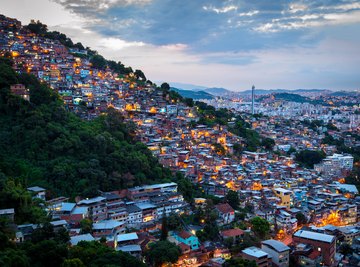
Population density is a term that expresses how crowded (or uncrowded) a particular piece of land is. Governments keep track of population density so that the people in charge have an idea of how many citizens live in a particular area and can provide services accordingly. In fact, the U.S. Census Bureau keeps close track of the population density in many areas of the United States so that it can coordinate with the National Hurricane Center to explain how many people and businesses a storm might affect.
Choose the area that you would like to calculate the population density for. The smaller your area gets, the more accurately your calculations will describe that particular area. Larger areas give you a much worse estimate of the population density at a given location. For example, if you calculated the population density of New York as a whole state, you might get a pretty average population density. However, if you calculated the population density of an area in upstate NY and an area in Manhattan, you would come up with two very different numbers, each of which would describe their area better.
Find the area of the place that you want to calculate the population density for. This area can be expressed in square miles, acres, or square meters, depending on your source. Just make sure that you keep the units constant through your whole calculation.
Find the population for your selected area.
Make a fraction with the correct units for population density. Scientists and sociologists usually express population density as a number of people per unit of area. Therefore, to create a correct fractional expression, you would need to have the number of people in the numerator (on the top of the fraction) and the number of square miles/meters/acres in the denominator (on the bottom.)
For example, a population of 8,341 people living in an area of 25 square miles would be expressed as a fraction: 8341 / 25.
Reduce the fraction to a unit area so that the final result is the number of people in one acre or square mile or square meter, for example. Another way to think of this is to carry out the division represented by the fraction. If you wanted to calculate the population density of a town that is 25 square miles and has a population of 8,341 people, you would divide 8,341 by 25 to get 333.64 people per square mile.
Round your answer from Step 5 up or down to a whole number, if necessary. The population density is simply an average, so you can end up with a decimal; however, the real population is composed of whole people, so rounding will express your answer in whole people as well.
References
About the Author
Ethan Schwartz has been a scientific and freelance writer for a year, writing scientific literature for "Gene Therapy" and articles on education, health and personal finance for eHow. Schwartz graduated in 2009 with a Bachelor of Science in biological sciences and will begin medical school in July 2010.