

What Are the Measurements for an Outdoor Shower?

Outdoor showers don't need to be elaborate; some don't even have shower walls. Nonetheless, it's important to consider privacy concerns and to check any applicable building codes or homeowners' association rules you may need to follow before you start setting the dimensions for your outdoor shower. Some homeowners' associations may have strict rules for outdoor showers, and others may ban them altogether.
Use and Location
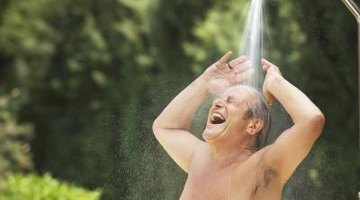
Strictly speaking, there are no standard measurements for outdoor showers. The shower’s location and its purpose are the best guides to follow when determining its measurements. For instance, some homeowners install a shower in a small space behind an existing stone or brick wall for privacy. Others install double shower stalls near their swimming pools to accommodate guests who want to rinse off after a swim. You might want to build a shower in a space close to your home to tap into existing hot and cold waterlines to avoid installing a new waterline.
Shower Stalls
Some ready-made outdoor shower stalls take up nearly 4 square feet of space and are 88 inches tall. Double stalls of the same height that are 4 feet deep may be about 90 inches wide. However, manufacturers’ dimensions will vary, and some offer custom sizes for shower stalls. Consider that adding seating, shelving and other fixtures to an outdoor shower will reduce the floor space and elbowroom inside the stall, no matter which dimensions you choose.
Portable Showers
An outdoor shower may not consist of much more than a shower head that protrudes from one side of a house because it’s connected to indoor plumbing. In such cases, dimensions are irrelevant if no exterior walls are built for the shower. Some portable outdoor showers have freestanding, adjustable shower heads that hook up to a garden hose spigot. The shower space is determined by a portable, weather-resistant floor that may measure 30 square feet or more.
Building Codes
Check your local building codes before you decide which type of outdoor shower you want as local laws may restrict the size of the shower. You may also have to follow drainage restrictions. Water that drains from an outdoor shower has to flow into a sewer system in some counties. Other areas allow outdoor showers to drain into the ground. In such cases, lining the space beneath the shower floor with landscape fabric to keep out weeds then covering the fabric with gravel can improve drainage.
References
Resources
Writer Bio
Frances Burks has more than 15 years experience in writing positions, including work as a news analyst for executive briefings and as an Associated Press journalist. Burks has banking and business development experience, and she has written numerous articles on consumer issues and home improvement. Burks holds a bachelor's degree in political science from the University of Michigan.
Photo Credits
- Christopher Robbins/Valueline/Getty Images
More Articles

