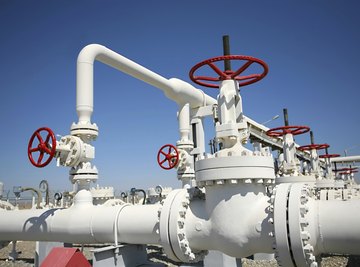

Natural gas is one of three major types of fossil fuels in use, the others being oil (petroleum) and coal. It is used in the United States mainly to produce heat and generate electricity. In 2018, natural gas accounted for 31 percent of total U.S. energy consumption.
Natural gas is measured in the U.S. at the level of domestic consumption in trillions of cubic feet (Tcf). Feet are an increasingly outdated form of linear measurement, and correspondingly, cubic feet (cf or ft3) are no longer a common unit of volume in the world at large, with meters (m) and cubic meters (m3) now the global standard for length and volume.
The energy sector, however, continues to use old-school measures of heat and volume. Heat, rather than being measured in joules (J), is usually traded and sold in terms of British thermal units (Btu). The amount of heat in a given volume of natural-gas-containing soil varies temporally and geographically, so the amount of Btu per cf varies slightly from place to place and from year to year.
Natural Gas Units of Measurement
It is important to note that prefixes are used in natural-gas measurements that mean something different than in other physics context. Specifically, "M" refers to "one thousand times" when referring to cubic feet of natural gas, instead of the standard "k" (for "kilo-"), and "MM" indicates "one million times," in contrast to the "M" ("mega") seen most often. Finally, "C" denotes "one hundred times," not to be confused with small-c "centi-" meaning "one hundredth."
A Ccf is thus the amount of gas in 100 cubic feet of soil, an Mcf is the amount in 1,000 cubic feet and an MMcf is the amount in one million (1,000,000 or 106) cubic feet. Similarly, 1 cBtu means 100 Btu, 1 MBtu refers to 1,000 Btu and 1 MMBtu denotes one million Btu.
Relationship of Cubic Feet to Cubic Meters
One meter is equal to 3.281 feet, making one foot equal to 0.3048 meters. This relationship can be used to relate volumes in the respective units to one another. One cubic meter is (3.281)3 cubic feet, or 35.31 ft3, and one cubic foot is (0.3048)3 = 0.02832 m3.
The Btu is defined so that under unvarying conditions over time and around the world, 1 cf should yield 1,000 Btu, or 1 MBtu, or heat. But because of the aforementioned correction factor, this varies slightly. For example, in 2018, the amount reported was in fact 1,036 Btu (1.036 MBtu) per cubic foot.
- A cubic foot in the natural gas industry is called a "standard cubic foot" (scm), but the "s" is normally omitted for clarity.
Converting From Cubic Meters to MMBtu
Once you know the most recent conversion factor to adjust the 1.000 MBtu = 1 cf relationship, a MMBtu conversion from cubic meters is simple.
First, if need be, convert cubic meters to cubic feet by multiplying by 35.31. Then, multiply this by the most recent conversion factor to get MBtu per cf (here, 1.036). Finally, determine how many MMBtu this is by dividing by 1,000, since 1 MBtu = 0.001 MMBtu.
Example: How much heat is in 10,000 cubic meters of soil, in MMBtu, using 2018 standards?
(10,000 m3)(35.31 cf/m3) = 353,100 cf
(353,100 cf)(1.036 MBtu/cf) = 365,812 MBtu
365,812 MBtu/(1,000 MBtu/MMBtu) = 365.8 MMBtu
You would use a similar process to go from MMBtu to scm (or just m3) in the opposite direction.
Converting Between Natural Gas Units
While this article serves as a handy m3-to-MMBtu calculator, you may need to work using other units. For this, you can refer to an online conversion tool (see the Resources for an example).
References
Resources
About the Author
Kevin Beck holds a bachelor's degree in physics with minors in math and chemistry from the University of Vermont. Formerly with ScienceBlogs.com and the editor of "Run Strong," he has written for Runner's World, Men's Fitness, Competitor, and a variety of other publications. More about Kevin and links to his professional work can be found at www.kemibe.com.
Photo Credits
insagostudio/iStock/Getty Images