How to Place Trees for the Best Shade on a House
Trees can be used to conserve energy by shading a house in the summer, which helps decrease the amount of air conditioning used. If deciduous trees, or trees that lose their leaves in the winter, are planted, sunlight shines on the house during the winter, warming the house for further energy conservation. However, if trees are planted too close to the house and create too much shade, mildew grows on the house, causing wood to rot and insects that live on decaying plant matter to invade the home. Also, wild animals can use the trees for access to the home's attic. Does this Spark an idea?
Instructions
-
-
1
Look at how the house is oriented according to the sun. During the winter, the house will receive the warming sun's rays from the south. During the summer, the house will receive the hottest sun from the southwest, so shading from the southwest is the most important to cool the house.
-
2
Choose the right kind of tree. Optimally, you want a tree that creates dense shade and grows to 60 feet with at least a 25 foot spread. However, if the house faces the west, you may want to plant several small trees instead of one or two larger trees. Remember, that during the hottest part of the summer, the mature tree will create a shadow at 4 p.m. that's as long as the tree is tall. Generally, the southwest or southeast side of the house is the best location for a shade tree.
-
-
3
Plant the tree far enough away from the house so that the mature tree will not become a vector for wildlife to enter the roof of the home. For example, if the total spread of the mature tree is 50 feet, then the limbs will spread 25 feet in each direction when the tree is mature. You will want a space of at least 15-20 feet from the house to the tip of the branch spread of a mature tree. Remember, that air circulation is as important as shade when keeping the house cool.
-
4
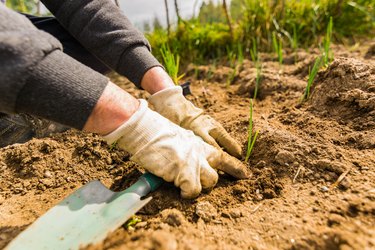
Use native soil in the planting hole and run water into the hole during the planting process to avoid forming air pockets.
-
1
Tips & Warnings
Don't plant fast-growing, low-quality trees. Many produce brittle limbs and don't live very long. Look for trees with an average lifespan of at least 75 years for a home landscape.
Avoid trees that grow very tall, such as some pine or poplars. Lightning strikes are common if the trees are the tallest structure in the neighborhood.