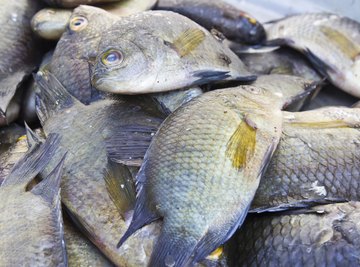

As for most fish, male and female tilapia look the same. The female lays eggs while the male fertilizes them, and this is a clue about how to tell them apart. Under the fish near the tail, there are several openings that are different in males and in females. This difference is used by fish farmers to identify the male fish, which they prefer because those fish grow bigger. Other differences between males and females are in the internal organs and the behavior after spawning. Tilapia are becoming a very popular food fish and knowing about the male and female fish differences and their reproductive cycle can help everyone appreciate how these interesting fish live.
TL;DR (Too Long; Didn't Read)
Male and female tilapia exhibit differences in size, behavior, internal organs and external genital openings. Internally, males have testes that produce sperm while females have ovaries to lay eggs. The males grow larger than the females and are therefore preferred for fish farming. To identify male fish, the fish farmer looks for the genital papilla on the under side of the fish, to the rear of the anus and before the anal fin. Males have one urogential opening while females have separate openings for urine and for eggs. Once the eggs are laid by the female and fertilized by the male, the female carries the eggs in her mouth until they hatch.
The Primary Male and Female Fish Difference
Although some fish can change their sex and the differences in the two sexes are less noticeable than for most mammals and birds, fish such as tilapia and pet goldfish are either male or female and their young are born after the fish bring together eggs and sperm. Some fish lay eggs into open water while the males scatter a large volume of liquid containing sperm in the hope that some of the sperm will reach a few eggs. Others lay eggs in protected places such as hollows in a lake or river bottom and the male can target his sperm better. Still others give birth to live young, with the male using a modified fin to place sperm near the female's oviduct and fertilizing the eggs inside the female. In each case, the primary difference between male and female fish is related to the sex organs.
Tilapia Differences
In tilapia, the female lays the eggs while the male fertilizes them with sperm. The female then takes the fertilized eggs into her mouth and carries them around until they hatch. Even after hatching, the female will still carry the fish fry ("fry" is a term for younger fish) in her mouth for a short period to keep them safe.
In addition to the female having ovaries to lay eggs and the male having testes to produce sperm, an external difference is that the female has separate openings for the eggs and urine while the male has a single opening for sperm and urine. The openings are found underneath the fish, in front of the rear anal fin and to the rear of the anus. The genital papilla of the female has a urinary opening and an oviduct while the male has only a urogenital opening.
Differences in Pet Goldfish
For comparison, look at goldfish. Pet goldfish have a slightly different method of reproduction and fewer differences. Both the male and female have a single opening, the cloaca, for eggs, sperm and waste. In the male, the cloaca is slightly concave while the female's cloaca protrudes a small amount. The female lays a large number of eggs that tend to stick to water plants while the male produces a large amount of milt, a fluid that contains sperm. Some eggs are fertilized and hatch to produce young fry. It takes about a year for a goldfish to mature fully.
How Fish Sex Works
The examples of tilapia and pet goldfish demonstrate how fish have the male and female sexes and how they rely on eggs fertilized by sperm. The details of how the fertilization is carried out and how the young are hatched can vary greatly. The main differences between the two sexes are related to the sex organs and the external openings for eggs and sperm. These can be completely different for the two sexes, as is the case in tilapia, or they can look almost the same, as for pet goldfish.
References
About the Author
Bert Markgraf is a freelance writer with a strong science and engineering background. He has written for scientific publications such as the HVDC Newsletter and the Energy and Automation Journal. Online he has written extensively on science-related topics in math, physics, chemistry and biology and has been published on sites such as Digital Landing and Reference.com He holds a Bachelor of Science degree from McGill University.
Photo Credits
useng/iStock/Getty Images