What does fact checked mean?
At Healthfully, we strive to deliver objective content that is accurate and up-to-date. Our team periodically reviews articles in order to ensure content quality. The sources cited below consist of evidence from peer-reviewed journals, prominent medical organizations, academic associations, and government data.
The information contained on this site is for informational purposes only, and should not be used as a substitute for the advice of a professional health care provider. Please check with the appropriate physician regarding health questions and concerns. Although we strive to deliver accurate and up-to-date information, no guarantee to that effect is made.
How to Treat an Oven Burn
Burning yourself on an oven is a surprising and upsetting event. Your skin may be sore, swollen, red or tender to the touch. In some cases, blisters can form at the burn site. Treatment of oven burns can usually be done at home by cooling the burn and applying protection to the skin. In extreme cases, such as blackened skin or numbness of the skin, the burn is considered a medical emergency and requires medical attention.
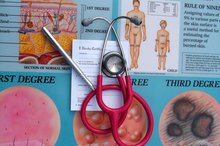
Evaluate the extent and severity of the burn. According to MayoClinic.com, first-degree burns affect only the outer layer of skin and cause pain, redness and swelling but do not cause blistering 2. Second-degree burns affect the outer layer of skin and the layer beneath. This causes pain, swelling and blistering. Third-degree burns can give the skin a white or black look, and skin may become numb. Third-degree burns are considered a medical emergency and should be treated by a doctor.
Treatments for Iron Burns
Learn More
If the skin is unbroken, run the burn under cool water or place in a cool water bath until the pain lessens. Do not put ice on the burn because this can further damage the burnt area. Cool temperatures help reduce swelling and pain.
Cover the burn with a dry sterile bandage or clean dressing while avoiding pressure and friction. Do not use cotton, which will easily enter the wound. Wrapping the burn keeps air from contacting the burn and protects blistered skin.
Home Remedies of a Blister Resulting From a Burn
Learn More
Take over-the-counter pain relievers such as ibuprofen or acetaminophen to reduce pain and swelling. Do not give aspirin to children younger than 12. Children recovering from the flu or chicken pox should never be administered aspirin.
Warnings
Do not burst blisters because this makes wounds prone to infection.
Related Articles

Treatments for Iron Burns
Learn More
Home Remedies of a Blister Resulting From a Burn
Learn More
How to Soothe Burns
Learn More

How to Treat a Burn From Kitchen Oil
Learn More
How to Treat Muffler Burns
Learn More
Home Remedy for Stove Burns
Learn More
How to Treat Grass Skin Burn Marks
Learn More

How to Care for Sunburned Skin
Learn More
How to Treat a Burn on a Forearm
Learn More
How to Treat a Brush Burn
Learn More
References
- MedlinePlus Medical Encyclopedia: Burns
- Mayo Clinic: Burns: First-Aid
- Mayo Clinic: Burns: Symptoms
- American Academy of Dermatology Association. How to Treat a First-degree, Minor Burn.
- Cleveland Clinic. Burns. Updated August 31, 2017.
- Agrawal A, Raibagkar SC, Vora HJ. Friction burns: epidemiology and prevention. Ann Burns Fire Disasters. 2008;21(1):3–6.
- Shahrokhi S, Jindal K, Jeschke MG.Three Components of Education in Burn Care: Surgical Education, Inter-professional Education, and Mentorship.Burns. 2012;38(6):783-789.doi:10.1016/j.burns.2012.01.012.
Warnings
- Do not burst blisters because this makes wounds prone to infection.
Writer Bio
Megan Kelly started writing professionally in 2007 when she was published in the anthology, "Lit Kids: Mama Bird and the Electric Rabbit" through Mill City Press. She is also a submissions reviewer and grant writer for "Spout Press," an independent magazine in Minneapolis. Kelly is pursuing her Bachelor of Arts in English literature from the University of Minnesota.