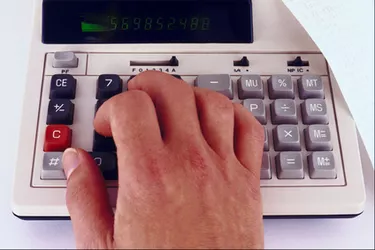
When studying loans or going through personal finances, it is possible to manipulate loan formulas to determine the original amount of a loan based on the payments on the loan. In addition to loan payments, to calculate the original loan amount you need the interest rate per month and the total amount of loan payments made. For example, a homeowner paid 20 payments of $500 each. The mortgage has a 6 percent interest rate during the year.
Step 1
Calculate the interest rate per month by dividing the interest rate by 12 months. In our example, 6 percent divided by 12 months equals 0.005.
Video of the Day
Step 2
Add 1 to the interest rate per month. In our example, 1 plus 0.005 equals 1.005.
Step 3
Raise the number calculated in Step 2 to the negative power of the number of payments made. So the negative number of payments made will be the exponent. In our example, 1.005 raised to the power of -20 equals 0.905062904.
Step 4
Subtract the number calculated in Step 3 from 1. In our example, 1 minus 0.905062904 equals 0.094937096.
Step 5
Divide the payment amount by the interest rate per month. In our example, $500 divided by 0.005 equals $100,000.
Step 6
Multiply the number calculated in Step 5 by the number calculated in Step 4. In our example, $100,000 times 0.094937096 equals an initial loan amount of $9,493.71.
Video of the Day