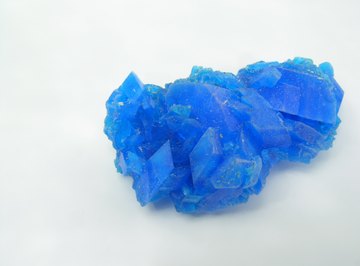
Copper (II) sulfate pentahydrate is a hydrated blue crystal. It is widely used as an algaecide and fungicide. To prepare a solution of copper (II) sulfate, the desired molarity is used to calculate the number of moles of copper (II) sulfate required. This number is then converted to an amount of grams that can be measured in a laboratory.
Calculating Gram Formula Mass
Write down the complete chemical formula for copper (II) sulfate pentahydrate. The Roman numeral II, for 2, relates the charge of the copper (Cu) in this compound is plus 2. The sulfate ion (SO4) has a charge of minus 2. So copper (II) sulfate's formula is CuSO4, and the compound is neutral. The pentahydrate part of the name means the compound has five (penta) water molecules (hydrate). Therefore, the full formula is CuSO4*5H2O. The dot in the middle indicates that the five water molecules are physically attached to the copper (II) sulfate compound.
Look up the atomic mass of each element on the Periodic Table. This number is usually located above the element symbol. Check the key on your Periodic Table to ensure you look at the correct information. To make calculations easier, round the atomic mass to the nearest whole number: Copper (Cu) is 64g/mole, sulfur (S) is 32g/mole, oxygen (O) is 16g/mole and hydrogen (H) is 1g/mole.
Add the mass of all the atoms in the chemical formula. Because the formula has only one mole of copper atoms, add 64g only one time. For oxygen, however, determine the total number of moles of atoms in the formula and multiply that number by 16g to get the total mass of oxygen in the compound. The equations are: Cu: 64g x 1 = 64 S: 32g x 1 = 32 O: 16g x 4 = 64 H: 1g x 10 = 10 ("5 H2O" means 10 H and 5 O are involved.) O: 16g x 5 = 80
The total is: 64 + 32 + 64 + 10 + 80 = 250g/mole = gram formula mass of CuSO4*5H2O.
Determining the Number of Moles
Write down the molarity formula. Molarity, or concentration, is equal to the number of moles of solute per liter of solution. Simplified, the formula is M = mol/L.
Plug your desired molarity and volume into the molarity formula. If you want to prepare 1L of a 0.2 M solution, for example, plug those values into the formula to solve for moles this way: M = mol/L and 0.2 M = x mol/1L.
Calculate the number of moles of copper (II) sulfate pentahydrate needed. This operation requires a simple cross-multiplication: x = (0.2 M) (1L) = 0.2 mol.
In this example, you would need 0.2 moles of copper (II) sulfate pentahydrate to make 1L of solution.
Converting Moles to Grams
- Periodic Table
- Calculator
The atomic mass on the Periodic Table represents the number of grams in 1 mole of an element. One mole is equal to 6.02 x 10²³ atoms. A hydrate is a solid substance that has water physically attached to its crystal structure. Copper (II) sulfate pentahydrate is commonly used as a component in fungal medications, batteries, mining, dyeing of textiles and electroplating as well as a pesticide Copper (II) sulfate pentahydrate can be obtained through several online stores.
When calculating the gram formula mass of copper (II) sulfate pentahydrate, include the mass of the water (5 H2O) that is physically attached to the compound. Shipping restrictions may apply when ordering copper (II) sulfate pentahydrate because it is classified as an environmental toxin.
Write down the mole calculations formula. It can be used to convert moles of a substance to grams of a substance and vice versa. Because the gram formula mass represents the number of grams in 1 mole of a substance, you can obtain the required mass for your solution by multiplying the number of moles by the gram formula mass. Simplified, the formula is: Number of grams = (number of moles) (gram formula mass).
Plug the gram formula mass you calculated previously and the number of moles calculated previously into the mole calculations formula. Using the earlier example, 0.2 moles of copper (II) sulfate pentahydrate are needed: Number of grams = (number of moles) (gram formula mass) Number of grams = (0.2 mol) (250g/mol)
Solve for the number of grams of copper (II) sulfate pentahydrate needed. An example is: (0.2 mol) (250g/mol) = 50g.
In that example, you would need to measure 50g of solid copper (II) sulfate pentahydrate in the laboratory and add water to make 1L of solution.
Things You'll Need
Tips
Warnings
References
About the Author
Jennifer Yadav is a professional writer who contributes instructional articles to a variety of websites. Yadav holds a Bachelor of Science and a Master of Education from the University at Buffalo, State University of New York.