
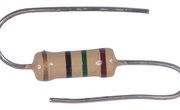
Almost all standard light emitting diodes require a voltage of between 1.5 to 4-volts to operate. Connecting the light emitting diode (LED) to a higher voltage will normally quickly destroy the LED, by causing it to burn out. However, many electronics stores sell LEDs which are marked as five-volt, and these can be directly connected to a five-volt power supply without damage. Although these are normal LEDs, they have an in-built resistor which drops the voltage down from five-volts to the voltage required by the LED. Five-volt LEDs can be connected to a nine-volt battery, but an external resistor is also needed in order to drop the voltage to the five volts required.
Calculate the Required Resistor Value
Find the current required for the LED from the LED packaging, or online from the manufacturer's material data sheet. This will be labeled as forward current and displayed in milliamps.
Calculate the resistor value using ohm's law, which states: voltage = current times resistance. The required voltage drop is four volts, as the battery provides nine volts and five volts is needed to power the LED. Putting the voltage drop and an example LED current of 20 milliamps into the equation gives: 4 = 0.02 x R. This can be rearranged as: R = 4 / 0.02 = 200 ohms. A 200-ohm resistor will be needed in series with the LED.
Calculate the required power rating for the resistor, using the formula: power = current times voltage. Putting the values into the equation above gives: power = 0.02 x 4 = 0.08 watts. Standard carbon resistors have a power rating of 0.25 watts, so 0.08 watts is well within their operating range.
Build the Circuit
- 5-volt LED
- 200 Ohm 1/4 watt resistor
- 9-volt battery
- Electrical wire
- Wire cutters
- Utility knife
- Soldering iron
- Rosin core solder
Online LED resistor calculators are available that perform the necessary calculations for you, once the details for the LED have been entered.
Do not connect the five-volt LED directly to the nine-volt battery, as it will quickly burn out.
Cut a piece of electrical wire to run between the positive terminal of the battery and the resistor. Remove a small amount of insulation from each end using the utility knife or wire strippers. Solder one end of the wire to a lead on the 200-ohm resistor.
Cut another piece of wire, and strip a small amount of insulation from each end. Solder one end of the wire to the free lead on the resistor and the other end to the positive connection on the LED.
Strip the insulation from the ends of a third piece of wire and solder one end to the negative connection on the LED. The other end will be connected to the negative terminal on the battery.
Connect the wire leading to the resistor to the positive terminal of the nine-volt battery, and the wire from the negative connection on the LED to the negative terminal of the battery. This causes the LED to light up, with the resistor protecting from the excess voltage.
Things You'll Need
Tips
Warnings
References
Tips
- Online LED resistor calculators are available that perform the necessary calculations for you, once the details for the LED have been entered.
Warnings
- Do not connect the five-volt LED directly to the nine-volt battery, as it will quickly burn out.
About the Author
Gareth Downes-Powell has been writing since 2000. He has contributed to a number of U.K. magazines, including "Web Designer," and has co-written four IT-related books published by Apress and Wrox. He has also worked as a technical editor on a number of titles for U.K. and U.S. publishers. Downes-Powell attended Thanet Technical College, achieving A-Levels in computer science, math and physics.
Photo Credits
red glow led image by Kir from Fotolia.com