

How to Build Steps to a Tree House

If you're planning to build a tree house, you need to build some type of access to it. If you're building the tree house for children, a height of 5 feet is optimal. Five feet may not sound very high, but for kids in a tree, it's high enough. For a frequently used tree house, a set of solid, easy-to-climb steps is the best choice. A homeowner with some experience in woodworking should be able to build this project in a few hours.
Preparation
Step 1
Ensure that the ground at the base of your steps is firm and level. Place one end of the first stringer on the ground and lean the other end against the tree house platform with the 2-inch side against the frame. Adjust the stringer to a 60- to 70-degree angle. Mark the bottom end of the stringer level to the ground. Cut the bottom of the stringer.
Step 2
Put the stringer back up against the tree house platform. Mark a vertical line at the top of the stringer and cut on the line to fit stringer to the platform. Attach stringer to platform with 3 1/2-inch galvanized deck screws.
Step 3
Once the first stringer is cut to fit properly, use it as a template to mark and cut the second stringer.
Step 4

Fasten both stringers to the tree house platform 16 inches apart with 3 1/2-inch galvanized deck screws.
Step 5

Mark every 8 inches on the inner face of one stringer for tread placement. This will give you a rise, or distance between steps, of 8 inches. Using a carpenter's level, make corresponding marks on the second stringer. Extend a level mark toward the back of each stringer across the inside face. These layout lines mark the top of each tread.
Step 6
Cut 2 by 6 lumber to 16-inch lengths for treads.
Step 7
Set each tread in place with 3 1/2-inch galvanized deck screws driven through pilot holes drilled in the outside of the stringer. Ensure that the top of each tread is on the top of its perspective layout line.
Step 8
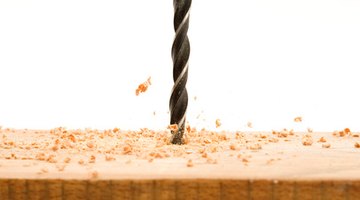
Reinforce each tread with a supporting 1 by 4 cleat. The cleats should fit at the end of each stringer from top of lower tread to bottom of tread above it. Use 2-inch screws driven through pilot holes you drilled to fasten the cleats to the treads.
Step 9
Finish ladder with a sealer for wood products, if desired.
References
- "Treehouses and Other Cool Stuff"; David and Jeanie Stiles; 2008
- "The Complete Guide: Build Your Kids a Treehouse"; Philip Schmidt; 2007
- "Treehouses and Playhouses You Can Build"; David and Jeannie Stiles; 2006
Resources
Tips
- The optimal angle for a ladder is 60 to 70 degrees.
- Fasten top end of ladder to the edge of the platform or extend beyond it.
- Instead of marking treads every 8 inches, you may increase the intervals to 10 inches for a higher rise that is still comfortable to use.
Warnings
- Do not select lumber with a lot of knots as this will compromise the strength of your stringers and treads.
Writer Bio
Based in eastern Virginia, Cathy Welch began writing nonfiction articles and novels in 1996. She wrote a short story that appears in John Maxwell’s “Everyone Communicates, Few Connect.” She writes reviews and nonfiction for Longridge Writer’s Group. Welch holds a Bachelor of Science in business administration from Christopher Newport University with a concentration in management.
Photo Credits
- construction image by Greg Pickens from Fotolia.com
- construction image by Greg Pickens from Fotolia.com
- level image by Albert Lozano from Fotolia.com
- screws image by Horticulture from Fotolia.com
- screws and heart shaped screws image by timur1970 from Fotolia.com
- lumber image by Kimberly Reinick from Fotolia.com
- Electric drill with a drill on a white background image by terex from Fotolia.com
- drilling a hole studio isolated over white image by dinostock from Fotolia.com
- pinceaux image by Philf from Fotolia.com
More Articles

