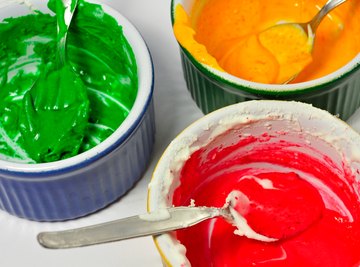

Learning about science concepts with elementary students is exciting when it is accomplished through fun experiments. These science projects using food coloring are acceptable for elementary school students. They encourages the children to use their imagination and learn about science. With some basic materials and food coloring, these projects can easily be done in the classroom setting.
Coloring Carnations
For this project you will need white carnations, food coloring, water and several clear jars such as cleaned pasta sauce jars. Gather the students and discuss the activity. Before doing experiments it is a good idea to come up with a hypothesis, or educated guess about what will happen. Explain that they will be placing carnations in water, but instead of clear water, the water will have food coloring in it. Ask the students if they think it will effect what happens to the flower. Have them write their entire hypotheses on sheets of paper.
Instruct the students to put water in the sauce jars and then add a couple drops of a selected color of food coloring. Mix the water and food coloring and then place one flower in each jar. Position a card in front of the jar with the date and time on it to acknowledge the beginning of the experiment. Have students check the flowers every day to see if anything has changed. Write observations on a paper. When a change is detected, gather the students and discuss a conclusion to the experiment.
Food Coloring and Milk
This project requires enough plastic plates for each student to have one, a half gallon of whole milk, liquid dish washing detergent, food coloring and cotton swabs. Give each student a plastic plate and a cotton swab. Pour enough milk in each plate to cover the bottom. Allow each student to drop three different color drops of food coloring onto their plate. Then have them dip a cotton swab in liquid dish washing detergent and lightly press it into the milk on their plate. Count to 10 and watch what happens. Continue dipping the cotton swab in the detergent and then into the milk.
Discuss with the students what is happening and have them try to figure out why the milk is reacting the way it does. Explain to the students that milk contains different materials such as fats and minerals. When the soap is added to the mix, it alters the solution and all the fats and minerals move around and react to each other causing the response in the milk and food coloring.
Color and Taste
Before doing this activity with elementary students make sure none of them have dairy allergies. Prepare for this project beforehand by mixing cream cheese with three different colors of food coloring such as green, blue and orange. Spread the colored cream cheese on crackers. Give each student a selection of crackers and have them write down what flavor each one is based on the color of the cream cheese. Have students taste each cracker and see if it is indeed the flavor they associated with the color. Write down which color was their favorite and why.
Poll the class to find out what color was enjoyed best by students. Discuss what colors and flavors they decided on. Explain to students that the only extra ingredient in the cream cheese was food coloring. Why did the color affect the way the cream cheese tasted? Our vision does play a role in how our brain registers taste.
References
About the Author
Sarah Lipoff has been writing since 2008. She has been published through BabyZone, Parents, Funderstanding and Education.com. Lipoff has worked as a K-12 art teacher, museum educator and preschool teacher. She holds a Bachelor of Science in K-12 art education from St. Cloud State University.