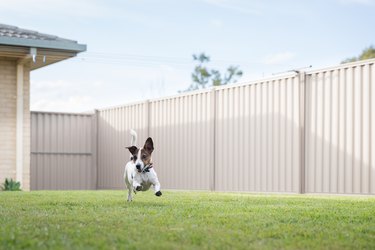
Hookworms can affect humans who walk barefoot in infested areas, but these parasites are generally a bigger issue in cats and dogs. These worms live in the intestines, and their eggs often pass along with feces. Exposure to the feces then infects another host. You're likely to encounter hookworms anywhere animals defecate, including in your yard as well as in kennels and dog runs.
Why It Matters
Video of the Day
Hookworms attach themselves to the intestinal wall, where they enjoy a blood meal. Unfortunately, the blood loss can cause hosts to become anemic, ultimately causing liver damage and other damage. The condition is most dangerous in young animals, like puppies, and it can prove fatal if left untreated.
Video of the Day
Hookworms aren't as likely to kill a human or older animal, but they can still make you quite sick. Infected humans may be asymptomatic or may experience abdominal pain, diarrhea, anorexia, weight loss, and fatigue in addition to anemia. Dogs and cats with hookworm may exhibit weakness, weight loss, itchy paws, diarrhea, and stunted growth.
Identifying Hookworm Problems
If you suspect there are hookworms in your lawn, you'll be disappointed to learn that you can't simply go look for them. Hookworm eggs are deposited in feces, but they're too small to see with the naked eye. The only way to detect them is to take a feces sample to your vet and have her take a look. If your pet has hookworms, you can safely assume that your lawn probably does too.
Preventing Hookworms in Your Yard
Hookworm spread via feces, so a tidy landscape is your best line of defense. Clean up after your dog every day and try to convince him to defecate in the same area all the time. This makes cleanup easier and ensures you won't miss anything. Hookworm eggs die in direct sunlight, so if you build an outdoor run or kennel, do so in a sunny area. You can also minimize the chance of hookworm survival by using gravel or concrete as the floor of your dog kennel.
You can further help prevent hookworm issues by watching what your pet eats. Hookworms can be ingested, so watch your pets carefully. You don't want your cat catching and eating an infected bird. Dogs eat just about anything no matter how disgusting, and potentially infected cat poop is absolutely on the menu, as are animal carcasses. Keep your pets away from these subjectively delicious snacks.
Treating Your Yard for Hookworms
If you already have a hookworm problem, you'll want to treat your yard to get rid of the worms. This is a tricky proposition, though. There are currently no insecticides proven to combat hookworms. Boric acid sometimes works, but it can also kill your grass. You can also try a broad-spectrum yard pesticide. Your best bet is to call a professional exterminator, however, and see what tricks he may have up his sleeve.
If you decide to go it alone, apply a liquid pesticide to damp grass at the rate recommended by the manufacturer. Irrigate the area with 1/2 inch of water so that the insecticide reaches the soil. If applying a granular product, irrigate with 3/4 inch of water after application. Keep pets and people off the lawn until it's completely dry after treatment.
In the meantime, treat your pet with a dewormer as directed by your veterinarian if he has hookworms. If you have more than one pet, deworming them all at the same time is an excellent plan. You can also consult your vet about prescription heartworm-preventing medication, some of which can also help prevent hookworms. This can get you through safely until the winter months come and kill off any hookworms in your yard.