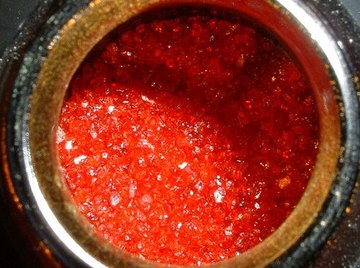

Potassium chloride, a table salt substitute, has the simple chemical formula KCl. It consists of one potassium atom combined with one chlorine atom. It might seem easy to react potassium and chlorine to form potassium chloride. While that does work, as will be shown, there are easier ways to prepare potassium chloride.
- Beakers
- Chemical reagents
- Safety equipment
React potassium metal directly with chlorine gas. (Do not actually carry out this reaction. It is dangerous and can be understood without doing so.)
In the reaction, the electropositive potassium atom loses an electron to form the ?1 ion, K?. Chlorine, a halogen, is electronegative and forms the ?1 ion equivalent, Cl?. The reaction between the two elements is:
2 K + Cl? ? 2 KCl
Combine potassium hydroxide with hydrochloric acid. This is an acid-base reaction, and is the easiest way to prepare potassium chloride. The reaction is:
KOH + HCl ? KCl + H?O
Replace the anion of a weak acid with the anion of a strong acid. As an example, potassium carbonate is the potassium salt of a weak acid--carbonic acid--H?CO?. Reacting it with hydrochloric acid forms the desired potassium chloride, while regenerating the carbonic acid.
K?CO? + 2 HCl ? 2 KCl + H?CO?
Exchange the anions of two salts. This reaction is useful if one of the salts of the products is insoluble. In the case of potassium chloride, potassium sulfate can be reacted with barium chloride.
K?SO? + BaCl? ? 2 KCl + BaSO??
Barium sulfate is one of the most insoluble substances known.
Become familiar with oxidation-reduction reactions.
Potassium hypochlorite reacts with sodium arsenite in the presence of alkali, in this fashion:
KClO + NaAsO? +NaOH ? KCl + Na?HAsO?
The potassium hypochlorite is reduced, and the sodium arsenite is oxidized. The chlorine goes from a ?1 to a ?1 state. In gaining electrons, the chlorine has been reduced. The arsenic loses electrons. It has been oxidized.
Things You'll Need
References
About the Author
Vincent Summers received his Bachelor of Science degree in chemistry from Drexel University in 1973. He furthered his education through the University of Virginia's Citizen Scholar Program program, taking many courses in organic and quantum chemistry. He has written technical articles since 2010.
Photo Credits
Image by Flickr.com, courtesy of Hey Paul