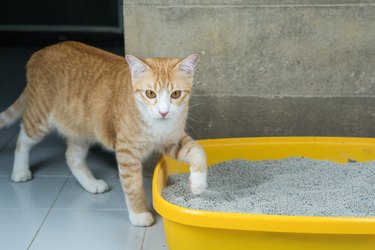
While your cat's urine is mostly water, it also contains chemical compounds such as ammonia that could contribute to human health issues. Like bottled ammonia, cat urine ammonia emits a strong odor that triggers asthma and allergy symptoms in those sensitive to it. In a home where the litter box is cleaned regularly, and the cats pee where they should, ammonia isn't usually an issue. At the opposite end of the spectrum, however, cat-urine residue and ammonia could cause serious health problems, even for otherwise healthy people.
Dangers of cat urine
Video of the Day
While cat urine may seem like a harmless and natural part of every feline's life, it could be harmful to human health in some situations. Cat urine is highly concentrated compared to the urine of humans, which means it can also emit a strong odor. Cat pee ammonia can irritate the eyes, nose, and throat. It can even cause headaches when the odor is extreme. A rare bacteria found in cat urine may cause serious health issues if it enters the bloodstream through contact with your skin. Fever, vomiting, diarrhea, and even kidney or liver damage are possible in extremely rare cases.
Video of the Day
Why it becomes an issue
Cats peeing in the litter box are little cause for concern, as long as the litter box is cleaned frequently. Some cats, especially unfixed males, spray urine on vertical surfaces from time to time instead of using the litter box. Unless you catch that cat in the act, you may not even know he sprayed your curtains or the couch. As the urine dries, it becomes more concentrated and starts to decompose, emitting foul odors. That smell won't go away completely until you've located and neutralized it.
The same holds true for cats that squat and pee outside the litter box. After doing this once, a cat is likely to urinate in the same spot again unless you've completely removed all evidence of the odor. The potential dangers of cat urine increase the more frequently the urine goes undetected around the house. Upholstered furniture, beds, rugs, and carpeting are particularly problematic peeing locations as the liquid is absorbed into its surroundings, making it harder to completely remove.
Long-term exposure issues
If you're living in a poorly ventilated environment shared by several cats, or a home in which the cat's urine isn't cleaned up right away, the air quality is compromised as ammonia becomes more prevalent. An overpowering ammonia stench could lead to lung irritation and coughing, respiratory infection, bronchitis, or pneumonia. The longer you're exposed to strong urine ammonia odors, the greater the chances of developing health issues.
A home that reeks of ammonia should be ventilated immediately by opening windows and doors and removing any objects laden with pet pee, such as couch cushions, pet beds, and the litter box. Wear a respirator that blocks ammonia odors when entering an extremely stinky location. Don't touch affected objects directly; instead, wear rubber gloves when handling suspect items. Wash the floors and any surfaces sprayed by cats. Throw any machine washable items in the washing machine and wash as directed on the care tag, without fabric softeners. Add 1 cup white vinegar to the final rinse cycle to help remove lingering odors.
In situations where cat urine has repeatedly soaked through the carpeting, steam cleaning it may not be enough. The pad and subfloor beneath the carpet may have absorbed the urine as well. In a worst-case scenario, sections of carpet, pad and subflooring may need to be replaced to completely get rid of such odors. Check other belongings such as mattresses and bedding, as well as carpeted stairs, cat trees, and areas surrounding the litter box to determine if any materials should be discarded to get rid of lingering odors.
Always check with your veterinarian before changing your pet’s diet, medication, or physical activity routines. This information is not a substitute for a vet’s opinion.