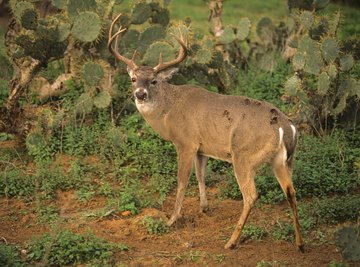

There are two species of Texas deer native to the state's vast and varied countryside: the white-tailed deer (Odocoileus virginianus) and the mule deer (O. heminous). The Lone Star State claims one of the largest populations of whitetails in the country: close to four million.
In addition to the two native types of deer, which can usually be easily distinguished based on physical appearance and ecology, several exotic species of deer have been introduced into the state for hunting purposes.
We'll go over each of these species and more in this article. Let's get started!
White-tailed Deer
White-tailed deer, the most widely distributed and evolutionarily ancient deer in North America, get their common name from the snowy underside of their tails, which they prominently flash when alarmed. While whitetail taxonomy is an unsettled business, four subspecies are historically described in Texas.
The Texas deer whitetail (O. v. texanus) occupies the broadest range, found across most of the central and western portions of the state. The Kansas whitetail (O. v. macrourus), typical of North America’s Osage Plains, ranges into northeastern Texas.
The remaining two subspecies have much more restricted geographies: The Avery Island whitetail (O. c. mcilhennyi) lives on the Gulf Coast of southeastern Texas and adjoining Louisiana, while the Carmen Mountains whitetail (O. v. carminis) is only found in the Sierra del Carmen and other scattered desert mountain ranges in the Texas-Coahuila borderlands.
Mule Deer
Compared to whitetails, mule deer -- named for their outsized ears -- have a small deep species range in Texas. The state harbors a pair of subspecies. The desert mule deer (O. h. eremicus) of the Southwest and northern Mexico roams the Trans-Pecos and Edwards Plateau. The Rocky Mountain mule deer (O. h. hemionus), the biggest and most widespread of all mule deer, inhabits the Texas Panhandle, possibly in a hybrid form with the desert mule deer. According to Texas Parks & Wildlife, the state likely harbors between 150,000 and 250,000 mule deer.
Comparisons Between Mule Deer and Whitetails
The ears of mule deer are proportionately much larger than those of whitetails. The white-tailed deer’s tail, meanwhile, is bigger and longer-haired than the mule deer’s, which is small and black-tipped. The antlers of mule deer bucks generally fork, while whitetail antler tines grow from a main beam; this characteristic, though, isn't a foolproof measure of identification.
Whitetails flee by dashing and plunging, while mule deer typically “stot” -- that is, they bound stiff-legged with all four hooves hitting the ground simultaneously. Ecologically, Texas whitetails favor heavy woods, thickets and dense brush, while mule deer more commonly range in open country.
These habitat preferences are starkest where the two deer overlap: On the High Plains of the Texas Panhandle, for example, mule deer forage on the open grasslands, while whitetails stick to the tangled draws and gallery forests. Where shrubs and trees invade former grassland or scrub, whitetails may increase at the expense of mule deer.
Exotic Types of Deer
Along with many other kinds of hoofed mammals, several exotic types of deer now reside in Texas, initially imported to private ranches for hunting purposes and to varying degrees now established in free-roaming populations.
Some 6,000 feral axis deer (Axis axis), a spotted species native to South Asia, inhabit Texas. Other exotics include the fallow deer (Dama dama), a small deer species from Eurasia, and another small deer species, the sika deer (Cervus nippon) of East Asia. These non-native species compete with native deer, particularly whitetails, and may otherwise disrupt indigenous ecological systems.
References
- Texas A&M AgriLife Extension: Deer of Texas
- Urban Wildlife Management; Kieran J. Lindsey, Clark E. Adams
- The Deer of North America; Leonard Lee Rue III
- Biology and Management of White-tailed Deer; David G. Hewitt (ed.)
- Deer of the World: Their Evolution, Behaviour, and Ecology; Valerius Geist
- Texas Parks & Wildlife Department: Mule Deer Management in Texas
- The Texas Almanac: Wildlife
- Texas Invasive Species Institute: Axis Deer
- Texas Parks & Wildlife Department: Exotics in Texas
About the Author
Ethan Shaw is an independent naturalist and freelance outdoors/nature writer based in Oregon. He holds a B.S. in Wildlife Ecology and a graduate certificate in G.I.S. from the University of Wisconsin-Madison. His primary interests from both a fieldwork and writing perspective include landscape ecology, geomorphology, the classification of ecosystems, biogeography, wildlife/habitat relationships, and historical ecology. He’s written for a variety of outlets, including Earth Touch News, RootsRated, Backpacker, Terrain.org, and Atlas Obscura, and is presently working on a field guide.
Photo Credits
Tom Tietz/iStock/Getty Images