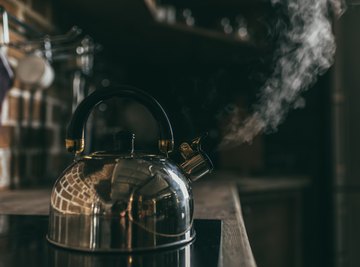

"A watched pot never boils" may seem like the ultimate truism when cooking, but under the right circumstances, the pot boils even faster than expected. Whether camping or chemistry, predicting the boiling point can be challenging.
TL;DR (Too Long; Didn't Read)
Determining boiling point based on pressure can be accomplished using equations, estimation, nomographs, on-line calculators, tables and graphs.
Understanding Boiling Point
Boiling occurs when the vapor pressure of a liquid equals the air pressure of the atmosphere above the liquid. For example, at sea level, water boils at 212°F (100°C). As elevation increases, the amount of atmosphere above the liquid decreases, so the boiling temperature of the liquid decreases. In general, the lower the atmospheric pressure, the lower the boiling temperature of any liquid. Besides atmospheric pressure, the molecular structure and attraction between the molecules of the liquid impacts the boiling point. Liquids with weak intermolecular bonds boil, in general, at lower temperatures than liquids with strong intermolecular bonds.
Calculating Boiling Point
Calculating boiling point based on pressure can be done using several different formulas. These formulas vary in complexity and accuracy. In general, units in these calculations will be in the metric or System International (SI) system, resulting in temperatures in degrees Celsius (oC). To convert to Fahrenheit (oF), use the conversion:
where T means temperature. As for atmospheric pressure, the pressure units cancel out, so which units are used, whether mmHg, bars, psi or another unit, is less important than being sure that all the pressure measurements are the same units.
One formula for calculating the boiling point of water uses the known boiling point at sea level, 100°C, the atmospheric pressure at sea level and the atmospheric pressure at the time and elevation where the boiling takes place.
At higher elevations, the lower boiling point of water requires cooking food for longer times to ensure adequate internal temperatures. For safety, use a meat thermometer to check temperatures.
The formula:
can be used to find an unknown boiling temperature for water.
In this formula, BPcorr means boiling point at sea level, BPobs is the unknown temperature, and Pobs means the atmospheric pressure at the location. The value 760mmHg is standard atmospheric pressure in millimeters of mercury at sea level and 0.045oC/mmHg is the approximate change in water temperature with each millimeter mercury change in pressure.
If the atmospheric pressure equals 600 mmHg and the boiling point is unknown at that pressure, then the equation becomes
Calculating the equation gives:
The units of mmHg cancel each other out, leaving the units as degrees Celsius. Solved for the boiling point at 600mmHg, the equation becomes:
So the boiling point of water at 600mmHg, an altitude of approximately 6400 feet above sea level, will be 92.8°C, or:
Warnings
Equations for Calculating Boiling Point
The equation detailed above uses a known pressure and temperature relationship with a known change in temperature with change in pressure. Other methods for calculating boiling points of liquids based on atmospheric pressure, like the Clausius–Clapeyron equation:
incorporate additional factors. In the Clausius-Clapeyron equation, for example, the equation incorporates the natural log (ln) of the starting pressure divided by the ending pressure, the latent heat (L) of the material and the universal gas constant (R). Latent heat relates to the attraction between molecules, a property of the material that influences the rate of vaporization. Materials with higher latent heats require more energy to boil because the molecules have a stronger attraction to each other.
Estimating Boiling Point
In general, an approximation of the drop in boiling point for water can be made based on altitude. For every 500 feet increase in altitude, the boiling point of water drops about 0.9°F.
Determining Boiling Point Using Nomographs
A nomograph can be also be used to estimate the boiling points of liquids. Nomographs use three scales to predict boiling point. A nomograph shows a boiling point temperature scale, a boiling point temperature at sea level pressure scale and a general pressure scale.
To use the nomograph, connect two known values using a ruler and read the unknown value on the third scale. Start with one of the known values. For example, if the boiling point at sea level is known and the barometric pressure is known, connect those two points with a ruler. Extending the line from the two connected knowns shows what the boiling point temperature at that elevation should be. Conversely, if the boiling point temperature is known and the boiling point at sea level is known, use a ruler to connect the two dots, extending the line to find the barometric pressure.
Using On-Line Calculators
Several on-line calculators provide boiling point temperatures at different elevations. Many of these calculators only show the relationship between atmospheric pressure and the boiling point of water, but others show additional common compounds.
Using Graphs and Tables
Graphs and tables of boiling points of many liquids have been developed. In the case of the tables, the liquid's boiling point is shown for different atmospheric pressures. In some cases, the table only shows one liquid and the boiling point at various pressures. In other cases, several liquids at different pressures may be shown.
Graphs show boiling point curves based on temperature and barometric pressure. The graphs, like the nomograph, use known values to create a curve or, as with the Clausius-Clapeyron equation, use the natural log of the pressure to develop a straight line. The graphed line shows the known boiling point relationships, given a set of pressure and temperature values. Knowing one value, follow the value line to the graphed pressure-temperature line, then turn to the other axis to determine the unknown value.
References
- Purdue University: Boiling
- Stanford University: Pressure-Temperature Nomograph
- University of Missouri St. Louis: Distillation
- National Institute of Health NCBI: Quantitative structure-property relationships for prediction of boiling point, vapor pressure, and melting point
- NASA Technical Reports: Altitude-Pressure Tables Based on the United States Standard Atmosphere
- Encyclopedia Britannica: Boiling Point
- Bulletin of the American Meteorological Society: Methods for Computing the Boiling Temperature of Water at Varying Pressures
- US Dept. of Commerce National Institute of Standards and Technology: Boiling Points of Benzene, Ethylene Chloride, n-Heptane and 2,2,4-Trimethylpentane
- University of Calgary: Micro-boiling Point Measurement
- University of California Davis: Calibrating Thermometers in Boiling Water-Boiling Point/Atmospheric Pressure/Altitude Tables
- Ohlone College: Clausius-Clapeyron Equation
- National Weather Service: Pressure Altitude Calculator
Resources
Warnings
- A current pressure lower than 760 mm Hg results in a negative number. Adding a negative number to 100 C leaves you with a number lower that 100 C.
About the Author
Karen earned her Bachelor of Science in geology. She worked as a geologist for ten years before returning to school to earn her multiple subject teaching credential. Karen taught middle school science for over two decades, earning her Master of Arts in Science Education (emphasis in 5-12 geosciences) along the way. Karen now designs and teaches science and STEAM classes.