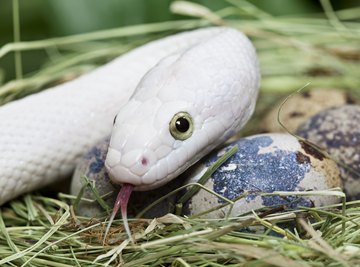

Reptiles come in all shapes and sizes, from tiny geckos to mammoth dinosaurs. Their reproductive methods and behaviors generally differ greatly from mammals, though there are some similarities. Among reptiles, differences in courtship rituals and reproduction can be quite different as well. Although most reptiles lay eggs like birds, some are in fact livebearers. There are even some female reptiles that don’t require the presence of males to produce offspring.
Sex Differentiation and Genitalia
Both male and female reptiles possess internal sexual organs that can be difficult to detect externally with the naked eye. The male reptile’s testicles are housed within its body. Males either have a single penis (turtles and crocodile) or two hemipenes (lizards and snakes) that can be detected externally by a pair of bulges behind the cloaca near the animal’s tail. Male genitalia is purely reproductive and separate from the urinary tract. Males and females can also be differentiated according to secondary sexual characteristics such as size, coloring, proportions and even horns.
Courtship Behaviors
Reptiles often display elaborate or unusual courtship behaviors prior to mating. Male chameleons, for example, change colors while attracting the female. Male turtles will often bob their heads up and down to attract female partners. The red-sided garter snake gathers in groups of up to 30,000 for what is often called a mating ball. Many species also release pheromones, chemical scents biologically designed to attract the opposite sex.
Breeding Methods
In reptiles, egg fertilization occurs internally when the male places his sperm inside eggs within the female’s body. The male does this by inserting his penis or hemipenes into the female cloaca. In many species, this sperm can remain intact for years so the female can produce additional offspring without any other male contact. Interestingly, some species of lizards actually produce offspring without males in a process known as parthenogenesis.
Oviparous vs Ovoviviparous
Most reptiles are oviparous, meaning they lay eggs that hatch outside the female’s body. However, a number of snakes and lizards are in fact ovoviparous, meaning they give birth to live young. Their eggs are housed internally and then hatch within the female’s body. The newborn animal emerges from the female much like it does in mammals, live and covered in embryonic fluid.
Care of Young
Most reptile species do not care for their young, who are left to fend for themselves from birth. Usually reptiles will hide their eggs in a hollow log or hole in the ground to protect them from hungry predators. Some snakes species, however, including pythons and mud snakes, protect their young by wrapping their tales around the eggs. Alligators place their babies gently in their mouths and carry them to water. The number of eggs a reptile produces varies a lot from species to species. Sea turtles lay up to 150 eggs each season, while African tortoises lay just one or two.
About the Author
Charlie Higgins is journalist, editor and translator based in Buenos Aires, Argentina. He has written for a variety of lifestyle and niche market websites, including International Food Trader, The Olive Oil Times, microDINERO, Sounds and Colours, Connecting Worlds and The Buenos Aires Reader.
Photo Credits
Alexey Kuznetsov/iStock/Getty Images