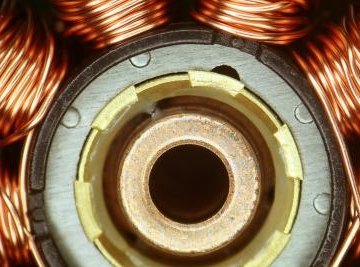

An electromagnet relies on the current flowing through a wire wrapped around a ferromagnetic core used to produce a magnetic field. The strength of the magnet is proportional to the applied current. Measuring the strength of an electromagnet requires a few simple tools.
- Electromagnet
- Battery or power supply
- Hook or stand
- Spring scale
- Weights
If using a power supply, change the current input and repeat this process to learn how the current input relates to the strength of the magnetic field.
Only use batteries or a low-voltage power supply for this process. Higher voltages can cause fires or electrocution if not handled properly.
Suspend the electromagnet from the hook or stand so that it hangs freely.
Connect the electromagnet to the battery or power supply. If using a power supply, turn it on.
Attach the spring scale to the electromagnet using only the magnet itself. The spring scale should stick to the electromagnet.
Add weights to the hook of the spring scale. Use care when adding the weights so that the force of the weights dropping does not dislodge the spring scale. Write down the weight indicated on the scale with the pencil and paper.
Continue to add weights until the spring scale falls from the electromagnet. Record the total weight that the magnet held before the scale fell.
Remove the weights from the spring scale. Repeat Steps 3 through 5 two additional times.
Calculate the average weight by adding the three recorded weights together and dividing by three. This is the strength of the electromagnet.
Things You'll Need
Tips
Warnings
Tips
- If using a power supply, change the current input and repeat this process to learn how the current input relates to the strength of the magnetic field.
Warnings
- Only use batteries or a low-voltage power supply for this process. Higher voltages can cause fires or electrocution if not handled properly.
About the Author
Susan Kristoff has been writing engineering content for 13 years. Her articles have appeared on eHow.com, Suite101, her personal websites, and the websites of many ghostwriting clients. Kristoff's expertise includes design, structures, sensors, data acquisition, and fabrication.
Photo Credits
Jupiterimages/Photos.com/Getty Images