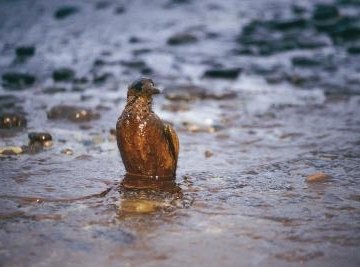

Removing oil from seawater can be a daunting task. Oil has a lower specific gravity (0.79 to 0.84) than seawater (1.023 to 1.028) and floats on top of seawater for that reason, which makes "skimming" one of the most effective "immediate" ways to remove crude oil from seawater. Other methods have been developed, including using a dispersant to sink the oil, bringing in "oil-eating" bacteria, and simply allowing the oil to break down through natural processes.
- Dispersant detergents
- Oil-eating bacteria
- Containment booms
- Boat equipped with oil skimming equipment
You can help prevent an environmental disaster. If you see or become aware of an oil or chemical spill, go to a phone and call 1-800-262-8200, the U.S. government's hotline for oil and chemical spills.
Oil spill management is a job for professionals. Report chemical or oil spills and follow the instructions you receive.
One method is to do absolutely nothing. The effects of solar radiation, wind, and current will disperse the oil, and eventually it will evaporate. The heavier parts that don't evaporate will sink. This method only works, though, when land areas, such as beaches, aren't in danger of being covered by an oil slick, and it maximizes the dangers to fish and wildlife exposed to the oil spill.
Using dispersants to sink an oil spill is frowned upon in U.S. waters. Dispersants act in the same way as a popular dishwashing liquid. They effectively eliminate the surface tension that prevents water and crude oil from mixing and break the oil up. The oil is then diluted by the water and "naturally" eroded.
Introducing "oil-eating" bacteria and nutrients, such as nitrogen and phosphorus, into a spill will speed up the natural degradation of the oil. Special bacteria can break the oil down into innocuous substances such as CO2 and fatty acids through a process called bio-degradation. Nutrients make the oil more "palatable" for the bacteria, so that they ingest more oil.
Setting fire to an oil slick removes the oil by converting the form of its potential energy to heat and light. This approach leaves behind a heavy carbon residue and is suitable only for use on the open ocean.
Oil slicks can also be removed with containment booms. After the slick is contained, a vessel equipped with skimming equipment can remove it. The skimmer is used to "vacuum" the oil slick--which is only a few millimeters deep--into a tank aboard the skimmer vessel. Skimmers don't work well in high winds or seas.
Things You'll Need
Tips
Warnings
References
About the Author
Will Charpentier is a writer who specializes in boating and maritime subjects. A retired ship captain, Charpentier holds a doctorate in applied ocean science and engineering. He is also a certified marine technician and the author of a popular text on writing local history.
Photo Credits
Stockbyte/Stockbyte/Getty Images