

How to Estimate the Number of Studs for Wall Framing

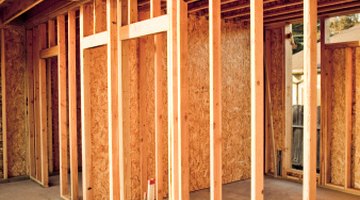
Estimating the number of studs you will need for a given framing project is one of the first steps of building and can be applied to almost any structure. The estimating process is a fairly simple task that grows easier with practice, and is a valuable skill to have in the building industry.
Things You Will Need
- Architect scale
- Calculator
- Pencil
- Paper
- Building floor plan
-
Measure a wall on the floor plan from corner to corner using your architect scale at the proper scale factor. The scale factor for the floor plan will be indicated near the page tiltle.
-
Multiply the number of feet in the wall by 12 to calculate the total amount in inches.
-
Divide this number by either 16 or 24 depending on what stud spacing is to be used, and add one additional stud to account for the end of the wall. This will be the number of studs needed for this wall on a basic framing application.
-
Add four additional studs for every opening (windows and doors) in the wall.
-
Repeat Steps 1 through 4 on all remaining walls in the structure.
Tip
Not all studs are created equal. For this reason, most estimators will add an additional 10 percent to the stud count to make up for any waste material, such as split or warped studs. For stud spacing, a good rule of thumb is 16 inches on center for exterior walls and 24 inches on center for interior non-load-bearing walls. Consult with a structural engineer for accurate stud size and spacing before finalizing any estimations.
The Drip Cap
- Estimating the number of studs you will need for a given framing project is one of the first steps of building and can be applied to almost any structure.
References
- "Estimating in Building Construction"; Frank R. Dagostino and Leslie Feigenbaum; 2002
Writer Bio
J. Cavan Barry is an architecture student with over a decade of experience in the general construction field, and four years in architecture. Barry also has nearly a decade of automotive repair experience and is an avid auto enthusiast. After finding an interest in creative writing, he began writing a novel and recently finished the first draft.
Photo Credits
- Hans Hansen/Lifesize/Getty Images
- Hans Hansen/Lifesize/Getty Images
More Articles

