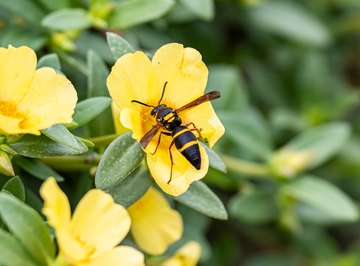

Despite their fearsome reputation, wasps aren't all bad. Many wasps help control pests in gardens and orchards, and many also serve, whether purposely or by accident, as pollinators. Some of the more beneficial wasps, like the mason wasp, look similar to less friendly wasps like the bald-faced hornet. Fortunately, the mason wasp (not to be confused with the mason bee) can be identified by color, behavior and nest.
Mason Wasp Description
"Mason wasp" refers to a group of closely related wasps belonging to the Eumeninae subfamily of the Vespidae family. This subfamily contains both mason wasps and potter wasps.
Mason wasps are large and mostly black, ranging from slightly over 1/2 inch to almost 3/4 inches long for the females and just under 1/2 inch to slightly over 1/2 inch for males. Like all wasps, mason wasps have little or no hair, unlike bees. The four-toothed mason wasp is black with a wide white band at the upper end of its abdomen, and the bald-faced hornet is a black wasp with white stripes at the stinger end of the abdomen. Four-toothed mason wasps and red and black mason wasps have a spot on their faces, unlike bald-faced hornets. As the name suggests, red and black mason wasps are black with reddish markings, although the males also have white or yellowish spots on their faces.
Mason Wasp Habits
Mason wasps are solitary wasps, unlike bald-faced hornets. Mason wasps use cracks and holes in wood and abandoned beetle burrows for their nests. Wasps in brick walls most likely will be mason wasps because some will dig into the mortar between the bricks. Some mason wasps build burrows in the ground, and some repurpose mud dauber nests.
Adult mason wasps feed on nectar but more commonly will be seen attacking relatively hairless caterpillars like cutworms and corn earworms. Mason wasps hunt caterpillars, keeping a supply in the nest and feeding these paralyzed insects to their larvae.
Interestingly, female mason wasps can control the gender of their offspring. Gender also plays a role in where the eggs are placed in the nest. Male larvae hatch sooner than female larvae, so some mason wasps lay a female egg on a caterpillar that she leaves in a far chamber of the nest that is sealed with a mud-like material, and then lay a male egg on another caterpillar in the next chamber, which she also then seals. Some mason wasps lay only one egg per nest while other mason wasps lay a series of eggs in the nest, although each egg has its own chamber. The four-toothed mason wasp creates a series of chambers; the first chamber contains the egg, the second is empty (this is called an intercalary cell), the next is filled with caterpillars as a sort of food storage area and finally there is another empty chamber.
Masonry Wasp or Masonry Bee?
Mason wasps might be mistakenly called masonry wasps. This confusion arises due to the similarly named mason or masonry bee. Like mason wasps, mason bees prefer to live in holes in wood and abandoned beetle burrows but also may be found in old mortar between bricks. At least one species of mason bee, however, nests in snail shells.
Mason bees differ from mason wasps in size, appearance and food preference. Mason bees generally are smaller, with only the largest mason bees reaching the smaller dimensions of mason wasps. Mason bee colors range from metallic blue or green to, less commonly, brown or black. Unlike mason wasps, mason bees are solid-colored and do not have stripes. Like other bees, mason bees have hairs to hold pollen as they move from flower to flower. Mason bees serve as important pollinators, especially in orchards. Mason bee larvae feed on bee bread made from pollen.
Mason Wasp Hazards
As wasps go, mason wasps are relatively benign. They may sting if disturbed, like most other bees and wasps, but as solitary or semi-social wasps they sting as individuals. Social wasps like yellowjackets and bald-faced hornets attack in large numbers, especially if their nest is threatened or disturbed. The sting of any wasp can be deadly to people allergic to the venom, but most people will simply find the sting temporarily painful.
If large clusters of mason wasps (or mason bees, for that matter) nest in brick walls, their digging damages the mortar between the bricks. This damage, if extensive, could compromise the structural strength of the wall.
References
- Bug Guide: Species Monobia Quadridens – Four-Toothed Mason Wasp
- University of Calgary: Vespidae
- Bug of the Week: Humans Help Wasps, Wasps Help Humans – Four-Toothed Mason Wasp (Monobia Quadridens)
- Ohio Department of Natural Resources: Common Bees and Wasps of Ohio
- University of Florida: Mason Wasps of Florida
- Texas A&M University: Beneficials in the Garden
- Pennsylvania State University Extension: Orchard Pollination – Solitary (Mason) Bees
- University of Nebraska-Lincoln Extension: Bees and Wasps Around the Home and Landscape
Tips
- You'll often see mason wasps feeding on the nectar of flowers. They are great pollinators in the absence of bees.
- Spot a mason wasp quickly by looking for its long, bluish-black wings and bold markings. Use a magnifying glass to study the mason wasp more closely for better identification.
Warnings
- Don't try to kill the mason wasps or destroy their nests. Mason wasps rarely compromise a building's structure when tunneling into the mortar. When the mason wasps abandon the nest they've built near the mortar, you can simply scrape it off.
About the Author
Karen earned her Bachelor of Science in geology. She worked as a geologist for ten years before returning to school to earn her multiple subject teaching credential. Karen taught middle school science for over two decades, earning her Master of Arts in Science Education (emphasis in 5-12 geosciences) along the way. Karen now designs and teaches science and STEAM classes.