

How to Test Soil pH With pH Paper

Table of Contents
How to use three methods of testing the soil pH: ph test paper, dye kits and pH meter with soil electrode probe.
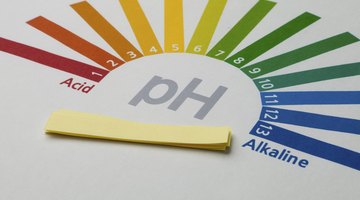
You don't have to be a chemist to perform a simple pH soil test in your yard or garden. You don't even have to understand the science behind this test to interpret the results. By using a simple piece of paper -- called a pH test strip -- you can see color-keyed results at a glance.
Using pH Paper
Things You Will Need
- Hand trowel or shovel
- Bucket
- Garden soil sample
- Measuring cup
- Lidded container, at least 1-cup capacity
- Distilled water
- Soil pH test strips
- Wristwatch, clock or timer
Tip
Soil pH test paper is not the same as litmus paper. Litmus paper changes to pinkish or purplish hues in the presence of an acidic or basic solution. Soil pH test paper has a greater sensitivity and shows a range of colors to pinpoint the pH.
Taking a Soil Sample
Before you perform a pH test, taking a soil sample is an important first step. Instead of removing soil from only one spot in your lawn or garden, you'll want to take representative samples from a larger area.
-
Take at least 10 soil samples from an area designated for growing common plants. For example, samples from your lawn, flower garden and vegetable garden should be tested separately.
-
Remove anything that covers the soil surface, such as mulch or thatch.
-
Use a hand trowel or shovel to slice into the soil -- to a depth of 4 inches in lawns and a depth of 6 inches for other areas.
-
Rock the handle of the trowel or shovel back and forth until you've opened up a small pocket in the soil.
-
Cut a slice of soil from the soil surface to the depth of the cutting tool, approximately 2 inches wide and 1/4 inch thick.
-
Place all the soil samples in a bucket, mix thoroughly and remove all vegetation and rocks.
- A soil pH test is not a soil fertility test. Apply fertilizer according to soil-test fertility recommendations.
Warning
Use a clean bucket that you haven't used to mix fertilizer or limestone in. Those materials could skew the soil test results.
Tip
Using Soil pH Paper
-
Place 1 cup of soil -- taken from the mixed sample in the bucket -- and 1 cup of distilled water into a lidded container.
-
Cover the container with the lid and shake it well.
-
Let the container sit, undisturbed, for at least 30 minutes to allow most of the soil sediment to settle to the bottom.
-
Take a 1-inch strip of soil pH test paper and touch the tip to the soil-water solution.
-
Keep the test paper on the surface of the water until the paper draws up at least 1/2 inch of water.
-
Match the color that appears on the tip of the test paper to the color guide that is included with the test kit to reveal the soil pH.
Paperless pH Testing Methods
The Dye Test
Using the same steps for collecting a suitable soil sample, you mix the soil water -- after the solids settle -- with premixed dye that comes in a kit. Typically, you mix the dye and soil solution in a small plastic container that has a clear viewing window on one side and colored thumbnails that corresponding pH readings on the other side.
Soil pH Meter
You can also use a soil pH meter in your garden instead of pH test paper. This instrument has a metal electrode probe attached to a meter that has a display for you to read the test results. Typically, you press the probe into the soil to a depth of 4 to 5 inches and leave it for 1 minute. The soil should be moist so the electrode probe can generate a current that conducts the resulting voltage to the meter.
Tip
A soil pH meter is an option for people who have color vision deficiencies, commonly called "color blindness," because they may be unable to distinguish the subtle shades of color on pH paper.
The Drip Cap
- You don't have to be a chemist to perform a simple pH soil test in your yard or garden.
- Instead of removing soil from only one spot in your lawn or garden, you'll want to take representative samples from a larger area.
- Match the color that appears on the tip of the test paper to the color guide that is included with the test kit to reveal the soil pH.
- Using the same steps for collecting a suitable soil sample, you mix the soil water -- after the solids settle -- with premixed dye that comes in a kit.
- You can also use a soil pH meter in your garden instead of pH test paper.
- This instrument has a metal electrode probe attached to a meter that has a display for you to read the test results.
References
Writer Bio
Victoria Lee Blackstone is a horticulturist and a professional writer who has authored research-based scientific/technical papers, horticultural articles, and magazine and newspaper articles. After studying botany and microbiology at Clemson University, Blackstone was hired as a University of Georgia Master Gardener Coordinator. She is also a former mortgage acquisition specialist for Freddie Mac in Atlanta, GA.
More Articles

