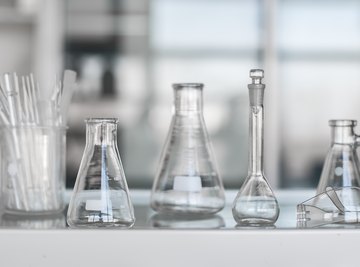

If you're working in a lab or taking a lab class, you'll encounter many different kinds of glassware, each of which has features that make it especially well-suited to certain applications. Lab glassware you're almost guaranteed to encounter includes flasks, beakers, pipets and graduated cylinders. Most serve as tools to measure out quantities of liquids; some are roughly accurate, others have great accuracy. Knowing the differences between the kinds of glassware available to you will help you design and carry out experiments more efficiently.
TL;DR (Too Long; Didn't Read)
Common lab glassware includes flasks, beakers, pipets, burets and graduated cylinders. Each is suited for storing, examining, and measuring liquids for different kinds of laboratory activities.
Types of Glassware
Erlenmeyer flasks have a narrow neck over a conical base, while beakers are basically large open-mouthed glass jars with a lip and spout for pouring. Graduated cylinders are tall cylinders with a spout to pour liquids; they have hash marks on the side to measure the volume of their contents. Volumetric flasks have a flat-bottomed bulb and a long, narrow neck with a hash mark along the side to indicate the point at which the flask is full. Burets are long, tall cylinders--generally much narrower and taller than graduated cylinders--with hash marks to measure volume and a stopcock at the bottom; the stopcock can be turned to allow the contents to drip out. Pipets are long narrow glass tubes with a bulb in the center, a hash mark to indicate when they are full, and a narrow tip. Sucking air from the pipet using a rubber bulb (like a turkey baster) draws liquid up through the tip into the pipet, and a precisely measured volume can then be transferred to another container.
Volumetric Glassware
Graduated cylinders, beakers, volumetric pipets, burets and volumetric flasks are five kinds of glassware often used to measure out specific volumes. Volumetric pipets, flasks and burets are the most accurate; the glassware makers calibrate these to a high level of accuracy. The accuracy is usually measured in terms of the tolerance, which is the uncertainty in a measurement made with the glassware. Class A volumetric glassware has a lower tolerance than Class B; for class A, the tolerance can be as low as 0.08 ml for a 100 ml flask or pipet. Generally, measurements with class A volumetric glassware can be considered reliable to two places after the decimal point.
Graduated Cylinders and Beakers
Graduated cylinders, beakers and Erlenmeyer flasks have less accuracy than volumetric glassware. Graduated cylinders can generally be considered reliable to within 1 percent. Beakers and Erlenmeyer flasks should not be used to measure volume unless you need only a very crude estimate because their accuracy for volume measurements is so poor. They can hold a much larger volume than any of the other types of glassware, however, which makes them useful for mixing solutions.
Functions
In general, beakers and Erlenmeyer flasks should be used to mix and transport chemicals during an experiment or to store waste. You can measure volumes with graduated cylinders if only limited accuracy is necessary; for greater accuracy, use a pipet or a buret. Burets are best for titration. If you need to prepare a solution of known concentration, always use a pipet and a volumetric flask--these items both have very low tolerance, so you can be more confident that the concentration of your solution is close to your calculated value. When recording data, remember to record uncertainties and to use the appropriate number of significant figures given the kind of glassware you used to take each measurement.
References
About the Author
Based in San Diego, John Brennan has been writing about science and the environment since 2006. His articles have appeared in "Plenty," "San Diego Reader," "Santa Barbara Independent" and "East Bay Monthly." Brennan holds a Bachelor of Science in biology from the University of California, San Diego.