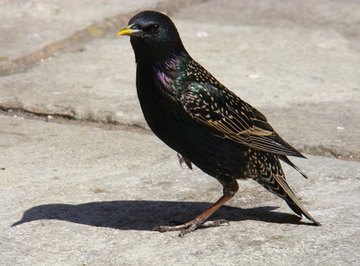

While some would argue that no bird can be a pest, the European starling presents a good counter-argument. The birds, introduced to North America from Europe in 1890, have become an invasive species, with the population booming over the last century. European starlings have massive flocks, with some composed of over 4,000 birds, and the speckled birds are loathed in agriculture: Annually, these blackbirds cause roughly a billion dollars of damage to the United States' agricultural industry – and when they arrive in or around a home garden, fruit and vegetable plants can be devastated. Combined with the health hazards their waste can create, it's no wonder that a number of tactics exist to keep starlings away.
TL;DR (Too Long; Didn't Read)
As the most notorious of U.S. nuisance birds, starlings can be dealt with in a number of ways -- some built as general bird deterrents, and some created specifically to handle starlings. These can vary from a change in what a bird feeder is filled with to the deployment of starling predators or sonic cannons. It is not advised to shoot the pest birds, however; while it is legal to do so, the risk of potentially harming a non-nuisance bird or breaking a local law is too great.
Simple Steps
The average person encounters the European starling as an annoyance in the garden. Known as one of a number of "bully birds," these birds have a habit of descending on bird feeders and clearing them out, while scaring away songbirds and other desirable animals in the process. They can also pick berry and vegetable plants clean, leaving a mess of the area. To deal with starlings in this setting, one of the easiest tactics to deal with the birds involve switching out the feed in a bird feeder or using a feeder designed to discourage starlings. Anti-starling feeders will keep the feed under a sloped cover, allow access only from below, or have a perch that closes off the access to food when a bird above a set weight lands. When changing feed, avoid suet and corn – which starlings love – in favor of safflower seeds, sunflower seeds inside the shell, or nyjer. Any feed on the ground should be cleaned away when possible. In the event that starlings take up roost in one of your trees, roosting can be discouraged by removing feeders from the area for a few days, and by playing starling distress calls over speakers pointed at the tree at night. After a few nights of this, the birds should disperse.
Deploy Starling Predators
If a large flock of starlings creates an issue on your property or in your neighborhood, services exist that will strategically deploy birds – often trained falcons or hawks – that will prey on the birds, disrupt their nesting habits and scare them away from the area. Sensory deterrents will have a similar effect: reflectors will disorient the birds as they fly and drive them away from the area, chemical applications will make the area unpleasant to be around and in some situations a shock track can be applied to ensure that the birds don't land on certain structures. Bird netting and angled metal can also be used to keep the birds out of certain areas.
Heavy Artillery
While it is ill-advised to shoot at European starlings for a number of reasons, in some situations it can be necessary to apply extreme countermeasures – often in commercial settings, where roosting birds can put drainage systems and HVAC equipment at risk of malfunction, or where their waste could become a cause for concern. These can range from starling traps to recently developed sonic cannons, which blast high-frequency noises that prevent starlings from communicating with each other, putting their survival at risk and causing them to flee the area. These tactics come with downsides, however; while they will keep starlings away, they will likely keep more desirable birds and animals away as well.
References
- Birds and Blooms: Bully Birds at Feeders
- FalconForce: Problem Birds
- Bird Barrier: Starling Control: How to Get Rid of Starlings
- The Spruce: Discouraging Starlings
- Bird B Gone: Keep Starlings off Your Property
- Bird-X: Starling Control
- Progressive Dairyman: Sonic Net Could Keep Starlings Away
- Backyard Chirper: How to Keep Starlings From Taking Over Your Bird Feeders
- Pennsylvania State University Extension: Controlling Birds Around Farm Buildings
- Washington Department of Fish and Wildlife: Starlings
- Stanford Essays: European Starlings
- University of Missouri Extension: Controlling Nuisance Blackbirds in Roosts
About the Author
Blake Flournoy is a writer, reporter, and researcher based out of Baltimore, MD. Working independently and alongside professors at Goucher College, they have produced and taught a number of educational programs and workshops for high school and college students in the Baltimore area, finding new ways to connect students to biology, psychology, and statistics. They have never seen Seinfeld and are deathly scared of wasps.
Photo Credits
Common starling,sturnus vulgaris,looking for his dinner image by shenk1 from Fotolia.com