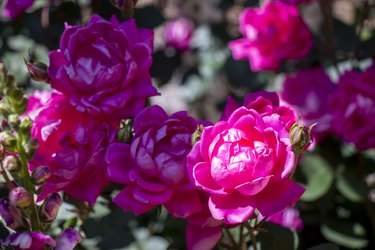
Your search is over if you've been looking for a rose (Rosa spp.) that doesn't require hours of maintenance to retain good looks and healthy growth. The Knock Out series of roses are relatively free of major pest and disease problems, and they don't require much pruning or deadheading to continue offering colorful displays of flowers in the garden.
Knock Out Rose Noteworthy Characteristics
Video of the Day
The first Knock Out rose was introduced to the consumer market in 2000. It was bred by William J. Radler and marketed by the Conard-Pyle company. Since then, it has become one of the most popular roses available due to its hardy nature and repeat blooming. 'Radrazz' was the original Knock Out sporting cherry-red blooms, which was the winner of the All-America Rose Selections in 2000. It's developed from a cross between 'Carefree Beauty,' 'Razzle Dazzle,' and an unknown seedling.
Video of the Day
Knock Out roses have two growth patterns with the vast majority growing into bushes ranging around 4 feet tall and 4 feet wide, which are hardy in USDA zones 5 through 10. However, there's a petite cultivar that grows to around 18 inches tall and 18 inches wide (Rosa 'Meibenbino'). All produce evergreen foliage that's serrated, ranging from glossy to dull, and in colors of greens to those with tinges of purple or blue. The lightly fragranced flowers bloom almost continuously throughout the year in hues of reds, pinks, white and coral with some having yellow centers.
Deadheading and Pruning Needs
Many types of flowering plants require deadheading to promote more blooms. However, this isn't the case with Knock Out roses. These roses continues to produce a wealth of flowers regardless of whether you deadhead or not as the plant is self-cleaning. Although not necessary, you can deadhead the spent blooms for a groomed look. When deadheading the spent flowers, always use clean pruning tools so you don't transfer unwanted pests or diseases to the rose. Using hand pruners, you can simply snip the spent roses from the plant.
When it comes to other types of pruning, you should wait until the rose bush has established itself in the planting site and has grown in the location for a couple of years. If the rose requires some shaping throughout the year, only remove one-third of the growth. However, in winter or early spring, you can hard prune the plant. Cut the canes down to about 1 foot, and by the end of the season, the rose bush will have developed its full size once again.
Knock Out Rose Continued Care
The best care you can give your Knock Out rose for optimal growth is making sure it's planted in its desired conditions of full sun and in soil that drains well with a pH of 6.0 to 6.5. Select a location where the rose has room to achieve its mature size without interference so it receives good air circulation to prevents potential disease problems.
Water several times a week while the rose establishes itself. Once established, water regularly while the plant is flowering and when outdoor conditions are especially dry and hot. Using a several-inch layer of organic mulch will help the soil retain coolness and moisture and reduce unwanted growth in the area. Although not big feeders, you can apply a general-purpose blend for roses after the rose finishes a cycle of flowering, if indicated by a soil test. Follow the directions on the package and water it into the soil after applying.