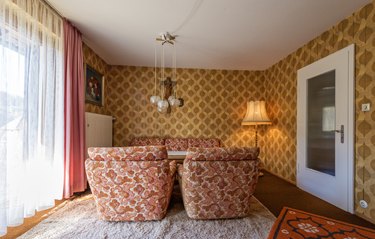
If your wallpaper has overstayed its welcome and you prefer to cover it up instead of removing it, none of your options should include pasting new wallpaper directly over the existing material — that's a recipe for bubbles and lifting paper. More viable options include installing paneling or tile. However, if you want to install new wallpaper or paint without removing the old wallpaper, skim coat the wall first using drywall joint compound, or install an extra layer of drywall.
3 Ways to Cover Up Old Wallpaper
- Install beadboard over it
- Install ceramic tiles on backer board on top of it
- Install new drywall and paint or skim coat over it
Video of the Day
Install Beadboard Over It
Nailing paneling, sometimes called beadboard, directly over the wallpaper is one of the easiest ways to cover it. Some panels are less than 1/4 inch thick and precovered with wallpaper. Preparation is minimal — simply pry off the baseboards and other molding, find the studs using a stud finder, and nail the plywood sheet to the studs with ring-shank finish nails. Coating the backs of the sheets with construction adhesive offers a more secure installation, but it isn't always necessary. Replace the baseboards and molding, and you're done.
Video of the Day
Install Ceramic Tiles on Backer Board
If you've always wanted to see tiles over that vinyl wallpaper in the bathroom, resist the temptation to glue them directly to the wallpaper. That's asking the wallpaper adhesive to support the tile, and it almost certainly can't.
Instead, you should screw sheets of 1/4-inch fiber cement backer board to the studs, using sheetrock screws. The backer board provides a waterproof and durable substrate for the tiles of your choice. Use the recommended adhesive for your tiles.
Paint or Skim Coat the Wall
If you prefer to paint over the old wallpaper or install new wallpaper, there are two ways to prepare the wall. You can install new drywall or skim coat the existing wall. Both methods are labor-intensive, but they produce quality results.
To install new drywall over old wallpaper, do the following:
- Screw in sheets of 3/8-inch drywall, which is thinner than the conventional material and intended for just this purpose.
- After screwing it to the studs and finishing it with joint compound and tape, you'll have a bare wall ready for anything.
Skim coating is a texturing technique that results in a flat, smooth wall. All you need to do it is all-purpose joint compound and a drywall knife. It's a messy procedure, so remove furniture from the room and cover the floor with drop cloths.
Things You'll Need
How to Skim Coat the Wall
1. Remove Loose Paper
Scrape off any loose or bubbling wallpaper with a wallpaper scraper. Wash the wall with soap and water. After making certain that no more paper will peel, prime the wall with PVA or drywall primer.
2. Apply Joint Compound
Spread a coat of all-purpose joint compound over the entire wall, and scrape it flat, using a 6- to 10-inch drywall knife. It's best to work in sections, starting at a top corner and working your way down and over. Apply a thin coat — don't try to do the whole job in one pass.
3. Skim Coat the Other Direction
Let the first coat dry, then repeat the skim-coating procedure, but change your direction by 90 degrees. You usually don't need to sand first, as long as you were careful not to leave high ridges or other defects on the first pass. Repeat once more after the second coat dries, if necessary.
4. Sand the Surface
Sand the final coat flat with a pole sander and 120-grit sandpaper. Wear a dust mask and open the windows.
5. Apply More Primer
Prime the wall once more with PVA primer. You now have a flat, smooth wall that's ready for papering or painting.