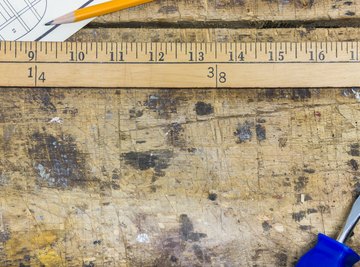
Although Imperial units of measure, or more accurately U.S. customary units, are usually used during everyday life in the United States, if you work in the sciences, there's a good chance you'll find yourself using metric units of measure like meters, centimeters and millimeters. All of these are present on the meter stick – essentially, a giant ruler that is a little more than 3 feet long. Just like a ruler, you can use the meter stick to read measurements on real-life objects.
Units of Measure on the Meter Stick
A meter stick will usually show at least three different units of measure. From smallest to largest, they're millimeters (which are so small their marks probably won't be numbered), centimeters and then the 1 meter denoted by the entire stick. Because there's just 1 meter in a meter stick, it might not be marked; but 1 meter is equivalent to 100 centimeters, which will be marked.
Some meter sticks will also have U.S. customary units on them, either on the flip side of the meter stick or marked out on the opposite side of the face from the metric measurements. From smallest to largest, the customary units you might see marked out on a meter stick are inches, feet and 1 yard. As with the 1-meter "mark," the 1-yard mark might not actually appear on the meter stick – but 1 yard equals 3 feet or 36 inches.
Tips
Not sure which units of measure you're looking at? Check out the numbers. If the numbers stop at 36, you're looking at a yard stick instead of a meter stick, or at least the inches/feet/yard side of a meter stick. If the numbers go all the way up to 100, you're definitely looking at a meter stick.
Reading the Meter Stick
Reading a meter stick works just like reading an extra-large ruler. Decide which unit of measure you want to read the measurements in. Then, line that side of the meter stick up with whatever you're measuring. Once that's done, shift the meter stick as needed so that the "zero" mark on the meter stick lines up with the point where you want the measurement to start. Finally, read the numbers along the meter stick until you reach the far edge of whatever you're measuring. Whatever number on the meter stick that edge lines up with is your measurement.
Tips
Here's a really neat trick for reading rulers or meter sticks in metric units. If whatever you're measuring falls between the marks for the units you've chosen, read the marks for the next smallest unit of measure down – usually millimeters – and insert these as a decimal following the main unit of measure. So if whatever you're measuring is 12 centimeters "and a bit more," you'll count off the number of millimeters in the bit more – say it measures 8 millimeters more – and give the final measurement as 12.8 centimeters. This only works with metric units, not U.S. customary units like feet and inches.
References
About the Author
Lisa studied mathematics at the University of Alaska, Anchorage, and spent several years tutoring high school and university students through scary -- but fun! -- math subjects like algebra and calculus.