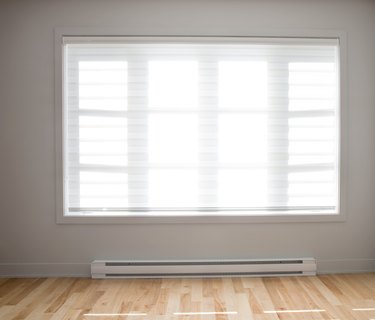
If you have a hot water heating system that's circulated through baseboard radiators, air will get trapped in the radiators and you'll need to periodically bleed them of this excess air. This is typically a DIY process, and it will make your heater run more efficiently.
Bleeding Baseboard Radiators
Video of the Day
Tiny air bubbles get trapped in radiators on a regular basis. The constant heating and cooling process combines the air bubbles into one larger bubble that eventually can block the water from circulating. This is called a hydronic airlock, and it means there's so much air in the system that water no longer circulates.
Video of the Day
You may notice that you don't have much or any heat coming from the baseboard radiators or you hear loud noises that occur each time water passes through the system. This is when you need to get to work to eliminate the problem. Unless your baseboard system is old, most baseboard radiators are set up for bleeding, and the valves used to bleed the radiators are usually easy to access.
Typically, baseboard radiators have an air bleeder valve on the baseboard piping, usually located near the top of the radiator. You can use a slotted screwdriver or radiator key to turn the valve. Take care to start the bleeding process when the baseboards are at room temperature, not warm. Many homeowners bleed their radiators at the start of the heating season.
Baseboard Bleeding Process
When you start the process, you need to turn the heating system on. Your system must be in operational mode in order to bleed the radiators. Start with the radiator farthest from your heating system. Once you've located the air bleeder, use the screwdriver or key to slowly open the valve by turning counterclockwise. Use a rag or bowl to catch the water that will drip out.
Turn the valve just a little bit at a time, and drops of water should be emitted. Air should be leaking out as well, and it's the air you want to release, not the water. Once there's only water coming out and no air, you're finished bleeding that radiator.
Move on to the next radiator closer to the heating system and repeat the process. Continue this process until you finish with the radiator closest to your heating system.
Baseboard Bleeding Tips
Older baseboard systems may have valves that are harder to locate. Some systems have a valve located on the boiler or the water pipes that extend out from the boiler. These are less effective, but you may not have a choice.
If you have a closed hot water loop system, as almost all baseboard radiator heating systems are, and the individual baseboards don't have valves, there is usually an air management system located at the expansion tank or where the water enters the loop. The other option is to drain the hot water system and refill it. This could trap more air, however. For this task, you may want to consider calling in a professional.
Good air management is needed for a boiler to function efficiently. Not only will you have less heat coming out of your radiators, but air in your system could also cause pressure problems for your boiler.