
Fundamental Skills & Rules in Badminton
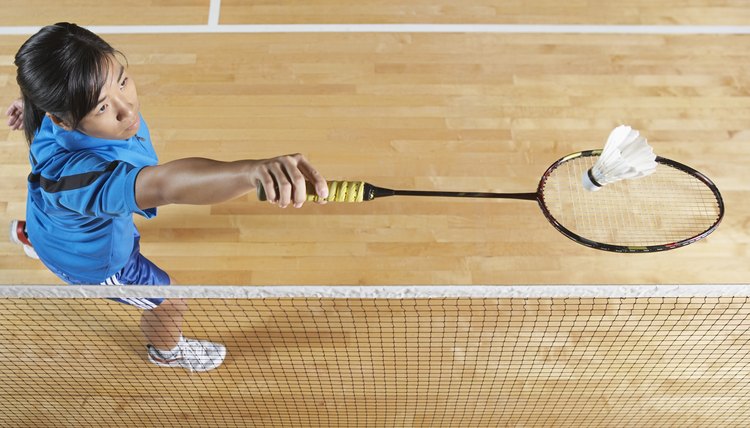
Badminton is a fairly easy game to learn and fun to play casually and competitively. Basic badminton skills include learning how you hold the racket, serve the shuttle and move your feet. You can practice drills to improve your game. Rules and scoring are established for singles and doubles games.
Grip
You will want to learn how to hold your racket with the forehand to hit shuttles on that side of your body and backhand to hit on the opposite side. You will use a forehand grip to hit above your head as well. You can hit the shuttle using a backhand grip with your elbow up or down. It is good to practice hitting with these grips to improve your skills.
Footwork
Your footwork can bring more success to your game if you learn the basics of moving on the court and practice them. Your ready position should include standing in the center of the court if you are playing singles and bending your knees with your body relaxed and waiting for play. Move your feet by shuffling them or gliding from left to right and stepping or lunging forward. To move backward, go fast enough that you get behind the shuttle to hit it hard enough.
Serving
Four types of badminton serves include: 1) the high serve to move your opponent to the back of his or her side of the court; 2) the low serve to make your opponent have to get under the shuttle; 3) the flick serve that is used occasionally to confuse your opponent who thinks you are going to hit a low serve; 4) the drive serve where you hit the shuttle low, fast and to the rear of the receiver's court as a strategy move that will result in a missed hit.
Scoring
Simple badminton rules include a scoring system where you play until you score 21 points. Three games constitute a match. A point is scored each time there is a serve and the side that wins the rally scores the point. You have to win by at least 2 points unless the game reaches 29 and there is still not a winner. The first side to score 30 points wins. If you win a game you will serve first in the next game.
Singles
To begin a singles game of badminton you will serve from the right side of the court. After the initial serve, the position depends on the server's score. If your score is even, you serve from the right and if it is odd you serve from the left. In addition, if the server wins the rally he will continue to serve, and if the receiver wins, the next serve goes to the receiver.
Doubles
In doubles play, serving goes back and forth between partners. The serving side is the same as in singles play in terms of even score serves from right and odd score from left. The serving partner alternates court sides if she continues to score during a rally and will serve until a rally is lost. When the serve comes back to the team the partner will serve next.
Additional Rules
The Badminton World Federation rules state that there is a 60-second interval when the winning team scores the 11th point. In addition, two-minute intervals are taken between games. If a match reaches three games, there is a change of ends when the winning side scores 11 points.
History
In August 2006, the Badminton World Federation, or BWF, changed the laws of badminton in order to add extra excitement to the game. The rule changes were designed to regulate the duration of each match and make the sport more appealing for television audiences. All court measurements and equipment laws have remained unchanged, as have the basic playing methods. The main changes have been to the scoring system.
History: Game Length Change
As with the former rules of badminton, you have to win two out of three games to win a match. However, the traditional 15 points format has now been replaced with a 21 points format. Before the rule changes, each game would be won by the first player to score 15 points, or 11 points for women. The new rules state that the first player to score 21 points will win each game. This rule applies for both men and women.
History: Scoring Change
The new scoring system has not lengthened the duration of each match. Due to the new points system, the game now flows more rapidly. Points used to be won only on the serve, meaning that the receiving player had to break his opponent’s serve in order to win the right to serve and therefore score points. The new rules have introduced what is known as a “rally scoring system.” A player or team can now win a point in any rally, regardless of who served.
History: Tied Games
The 21 point format has also brought in new laws for tied games. According to the official Badminton World Federation Laws of Badminton, “If the score becomes 20-all, the side which gains a two point lead first, shall win that game.” If the score becomes 29-all, the player or team to score the 30th point will win the game.
History: Comparative Changes
The new badminton rules have reduced the playing time needed to complete a full match. According to the Badminton Information website, it was not uncommon for an old format match to last for two hours. The new rules have reduced the average match time to about an hour. The rally scoring system has also changed the tactical nature of the game. As the Badminton Information website states, “Avoiding making unforced errors is crucial here because every rally counts.”
Writer Bio
A wellness coach, Vicki Zerbee has been writing health and lifestyle articles since 1999. Specializing in fitness, nutrition, weight loss and anti-aging topics, her work has appeared on websites such as Divine Caroline and Bright Hub. Zerbee has a certificate of accounting from Bradford Business School and a professional certification in inbound marketing from HubSpot.