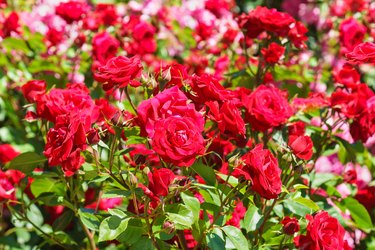
Learning how to grow and care for roses (Rosa spp.) properly results in beautiful fragrant blooms that light up your flower garden. If you're under the impression that roses are hard to grow, the good news is that it may not be the case, depending on the type of roses you grow. Give roses sufficient sun and water, watch for pests and diseases and treat quickly at the first signs of distress, and you'll have success.
Choosing Roses for Your Garden
Video of the Day
Roses come in two different forms for planting. In the late winter and early spring months, you'll find roses in bare-root form. This is a rose bush in a dormant state with very little to no foliage. Bare root is the least expensive way to buy rose bushes. Buying bare root sometimes also gives you a greater selection from which to choose.
Video of the Day
You can find actively growing rose bushes in the spring and summer months in nurseries. These potted plants are often flowering. Buying roses that are already growing allows you to see what the flowers look like and how they smell.
Planting Rose Bushes
Roses require full sun to thrive and produce plenty of blooms. Choose a location that gets six to eight hours of daily sunlight. If you live in an arid, desert-like climate, select a planting site that gets some afternoon shade. In cold climates, place the rose near a west- or south-facing wall and avoid low-lying areas. This will help ensure that the rose bush avoids freezing during the winter months.
The planting site should have rich soil that also drains well. Roses do poorly when their roots remain wet. Loosen the soil by amending the planting area with compost. It's also important to plant in an area that has good air circulation. Sufficient airflow helps prevent pests and diseases.
Care for Roses: Watering
Roses require regular watering. This is especially important in the first several months while the bush becomes established. When there is no rain, water twice a week. Soak the area surrounding the rosebush well.
To conserve water and prevent weeds, mulch roses with shredded bark. Pull the mulch back two inches away from the base of the plant so that it doesn't touch the canes. Water the soil well before putting down mulch, and then water again once you've mulched. This will help seal the mulch onto the soil so that it will conserve moisture.
Fertilize Roses Regularly
Roses require regular fertilization to do well. Fertilize the plants on a monthly basis from late winter through early fall, or according to label directions. using a fertilizer designed for roses. This product will have the right amount of nitrogen, phosphorus and potassium to facilitate healthy root and foliage growth and prolific flowering. Follow the package instructions exactly. Watering the rose bush when you fertilize helps activate the fertilizer and protect the plant's roots.
Prune Roses Often
Regular rose pruning helps the bushes continue to bloom. When you prune off spent blossoms, this initiates more flowering on repeat-blooming types. Even though some types of roses bloom only once a year, they'll look tidier if you remove the spent flowers. To prune, cut just above a leaf using sharp, sanitized pruning shears. Prune to create a pleasing shape and to remove any branches that are in pathways. Also, cut any dead or dying stems.
Protect Roses in Winter
If you live in a climate that experiences freezing temperatures in winter, it's important to protect your rose bushes. After the first two to three weeks of below-freezing temperatures, cover the base of each rose bush with mulch. Then place straw, leaves or pine tree branches on tops of the rose canes. This will help protect the plant's roots during freezing temperatures.
Prevent Pests and Diseases
The best way to avoid pests and diseases is to prevent them in the first place. In order to do this, keep the rose bush strong by watering it well and fertilizing regularly.
If your rose bushes do develop pests, such as aphids, scale or spider mites, begin by washing the pests off with a strong blast of water. If the pests return, treat with insecticidal soap. When a rose bush develops fungal disease, such as rust or powdery mildew, treat with a fungicide.