

Fast Growing Tall Hedges

Fast-growing shrubs and trees can make your back yard a private oasis in just a few years. Aside from privacy, tall hedges also can become living fences or windbreaks and provide a natural sound barrier. Several species and varieties fit the bill, giving you options to suit your style and desires.
Coniferous Evergreens
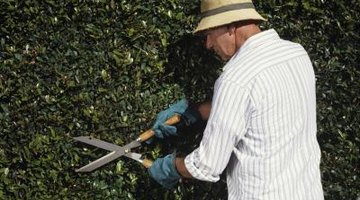
A few kinds of coniferous, or cone-producing, evergreens quickly form a hedge or screen and provide dense, year-round foliage.
An example is "Green Giant" arborvitae (*Thuja standishii x plicata "Green Giant") is among the fastest growing trees available for a tall hedge, screen or wind block. This hybrid is hardy in U.S. Department of Agriculture plant hardiness zones 5 through 7 and grows rapidly: It can reach 30 feet tall in 30 years and reach upward of 60 feet at maturity. Because of its height, this variety may not do well on small sites. Other arborvitaes may work better on small lots.
"Spartan" juniper (Juniperus chinensis "Spartan"), which is hardy in USDA zones 5 through 9, is a strong, columnar and pyramidal coniferous evergreen that grows up to 15 feet tall and 5 feet wide at its base. This fast-growing juniper doesn't need pruning to maintain its symmetrical shape, although it handles pruning and makes an ideal topiary specimen. "Spartan" is heat- and drought-tolerant.
Broadleaf Evergreens
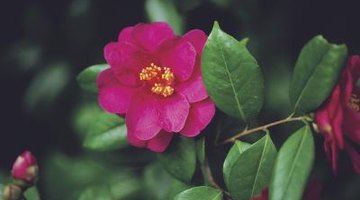
If you're after year-long color but don't want coniferous evergreens, then consider the several broadleaf evergreens that are fast-growing and tall, making them ideal for privacy hedges and screens.
In warm areas of the United States, cherry laurel (Prunus caroliniana) may be the solution. This fast-growing evergreen tree can reach up to 40 feet tall and is hardy in USDA zones 8 through 10a. Shorter varieties of it are available.
"Yuletide" camellia (Camellia sasanqua "Yuletide") is hardy in USDA zones 7 through 10 and offers large, single, red blooms with yellow stamens. Like other camellias, this variety has large, glossy, green, evergreen foliage. A shrub, it grows 8 to 10 tall feet tall and is a moderate- to fast-growing specimen. As a hedge or screen, it produces a dense wall with mid-season blooms.
Deciduous Shrubs
Deciduous shrubs lose their leaves in autumn and winter, lessening the privacy they offer. Many of them, however, have dense branching that still provides some privacy even without the foliage.
One example is lilacs (Syringa spp.), which typically are hardy in USDA zones 3 through 8, with some variances among species and cultivars. Shrubs in this genus are known for their large, intensely fragrant, conical flower clusters in shades of white, pink and purple. Lilacs as a group are fast-growing, allowing you to have a dense, fragrant and showy hedge within a couple years. Chinese lilac (Syringa x chinensis) is hardy in USDA zones 3 through 7 and creates a robust, 15-foot hedge. Several lilac species and cultivars are readily available in varying sizes, colors and bloom times.
Another deciduous shrub, forsythia (Forsythia spp. and cvs.) produces bright-yellow flowers in early spring and is hardy in USDA zones 4 through 9. Known as a harbinger of spring because its flowers come out when temperatures are still cold, forsythia can be a visually interesting hedge. It handles partial shade and does well in full sun. The species shrub can grow 10 feet tall, and its numerous cultivars reach varying heights.
Hedge Considerations
All plants have a recommended spacing guide to help homeowners determine how far apart to plant them. Plant spacing for a hedge may differ, though. For example, lilacs typically are planted 10 to 15 feet apart, depending on their mature size, but they are planted only 6 feet apart for a hedge. The closer plantings allow for a denser hedge.
Pruning requirements may also vary, based on whether the plant is used as a hedge or single specimen. For example, prune cherry laurel for a finished look when it is in a hedge; left not pruned, it grows into a dense, upright oval specimen. Most shrubs sold as hedges take well to pruning and shaping. In many cases, pruning boosts new growth potential, making a denser hedge that provides more privacy. As a general rule, prune spring-flowering shrubs after they finish blooming; prune summer-flowering shrubs in early spring. Most evergreens are pruned in early spring prior to their natural flush of new growth.
References
- Monrovia: "Spartan" Juniper
- Monrovia: "Yuletide" Camellia
- Fine Gardening: Chinese Lilac
- Fine Gardening: Forsythia
- Iowa State University Extension and Outreach: Horticulture and Home Pest News -- Growing Forsythias in the Home Landscape
- University of New Hampshire Cooperative Extension: Growing Lilacs
- Clemson Cooperative Extension: Forsythia
- The Morton Arboretum: Pruning Evergreens
Resources
Writer Bio
With a professional background in gardening, landscapes, pests and natural ecosystems, Jasey Kelly has been sharing her knowledge through writing since 2009 and has served as an expert writer in these fields. Kelly's background also includes childcare, and animal rescue and care.
Photo Credits
- George Doyle/Stockbyte/Getty Images
- TongRo Images/TongRo Images/Getty Images
More Articles

