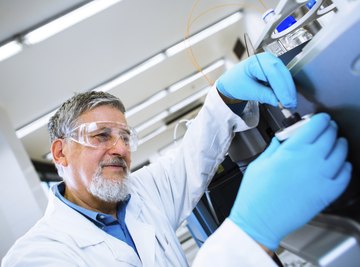

Developed in the early 20th century, gas chromatography (GC) is a method used to separate and analyze the components of mixtures -- particularly mixtures of volatile liquids like benzene. This separation is achieved by first vaporizing the mixture; a mass spectrometer attached to the chromatography unit is then used to properly identify the compounds within the mixture.
Using Volatility
After a sample is injected into the chromatography machine, mixture is vaporized and the components are carried through a tube by an inert gas. In the tube, the vaporized components pass through a liquid, or stationary phase, within the tube. The stationary phase is used to inhibit the gases from passing completely through the column. The more volatile the component, the less it interacts with the stationary phase. Hence, the faster a gas passes through the tube -- the more volatile it is.)
Detecting the Components
At the other end of the tube lies a detector designed to sense each component of the mixture. As the compound leaves the tube, the detector is able to gauge the amount using one of several methods. Some detectors use a flame to burn a sample, generating ions. These ions are detected by measuring the electrical conductivity of the flame. Another type of detector measures the presence of a vaporized sample by changes in the carrier gas conductivity.
Reading the Results of the Detector
The data output from the detector appears as a line graph, with the amount of compound detected shown against time. The most volatile compound appears first as a peak on the graph. Subsequent peaks on the graph represent progressively less volatile components of the original mixture. Scientists can use these chromatograms to further break down the chemical properties of a sample mixture, with the proportion of peak sizes being relative to the amounts of the substances in the sample. Scientists use the areas under the peaks to determine their sizes.
Mass Spectrometer
A mass spectrometer is particularly useful when analyzing the composition of an unknown mixture. The combined gas chromatography-mass spectrometry (gc-ms) unit scans the masses of the components as they move out of the tube. The mass spectrometer fires energetic electrons at the moving vaporized sample, ionizing its molecules. An analyzer then sorts through the ions using their mass-to-charge ratio. The combined gc-ms units are ideal because they can instantly determine the masses of components and can identify components that don't completely separate.
References
About the Author
Brett Smith is a science journalist based in Buffalo, N.Y. A graduate of the State University of New York - Buffalo, he has more than seven years of experience working in a professional laboratory setting.
Photo Credits
ViktorCap/iStock/Getty Images