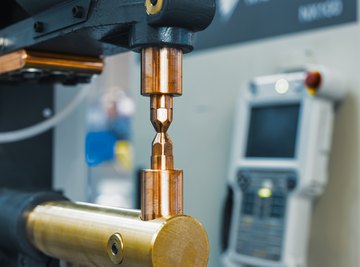
Spot welding is a process in which two metal surfaces are melted together to form a weld. A pair of electrodes simultaneously clamps the work pieces together and delivers the electrical current needed to make the weld. The two electrodes focus the current onto a small spot, which is where the term “spot welding” comes from. Aluminum spot welding is becoming more common as aluminum replaces steel in many applications where weight is important, such as automobiles.
Use three-phase electrical power to spot-weld aluminum. This type of electrical power is needed for the large output current that spot welding requires. Spot welding typically delivers current for 0.1 seconds or less, so the current must be extremely high. Spot-welding machines typically deliver 150 amps per phase draw on a 440-volt system. A new spot-welding machine usually costs between $60,000 and $85,000 and a rebuilt spot welder $25,000 to $35,000.
Select capacitor discharge welders. These welders use a capacitor to store and deliver the extremely high current required to perform spot welding. The primary advantage of capacitor discharge welders is that they require a minimal power draw, which allows smaller plants to perform spot welding without upgrading the electrical supply. This enables assembly lines to use spot welding on thicker pieces without the lights flickering.
Consider the physical properties of aluminum when performing spot welds. Aluminum conducts electricity and heat very easily, so it must be welded more quickly than steel to avoid overheating the work pieces. Aluminum typically requires two to three times the current and one-quarter of the weld time that steel does. The extremely high current and short weld times mean that the electrodes must be water-cooled.
References
About the Author
Allan Robinson has written numerous articles for various health and fitness sites. Robinson also has 15 years of experience as a software engineer and has extensive accreditation in software engineering. He holds a bachelor's degree with majors in biology and mathematics.