How to Check the Engine Light on Vehicles
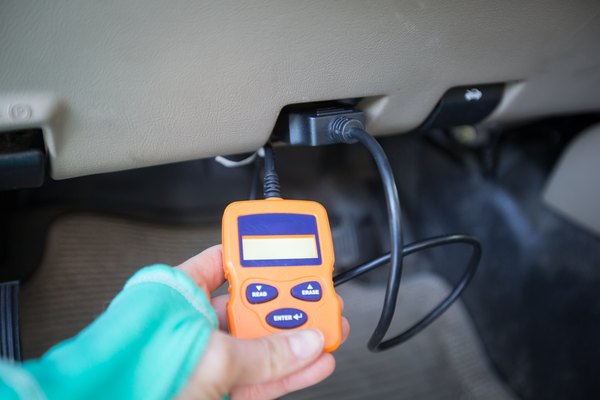
by Contributing WriterUpdated June 12, 2017It is a compact Vehicles manufactured by the Korean automaker. You can check the engine light on your Vehicles right from home, saving yourself a trip to the dealer. The Vehicles illuminates the Check Engine light on your instrument panel when the On-Board Diagnostics computer detects an error code sent to it from one of the sensors in the engine or emissions system. You can find out what the Check Engine light means by purchasing an OBD code scanner from an auto parts store. This code scanner reads the codes, and tells you exactly what is wrong with the Vehicles.
Under The Hood:
- How to Check the Engine Light on the 1997 Honda Accord
- How to Check the Engine Light on a Subaru Legacy
- How to Check the Engine Light in a Kia Sportage
- Check Engine Light on Dodge Caravan
How to Check the Engine Light on the 1997 Honda Accord
Remove the ashtray from the center dashboard of the 1997 Honda Accord. Set the ashtray aside.
Connect the plug of the OBD II scanner into the diagnostic/data link connector (DLC) now revealed by your removal of the ashtray.
Place the key in the ignition and turn the key two clicks forward to the "II" position--also known as the KOEO (key-on/engine-off) position.
Follow the menu of the OBD II scanner to determine which code(s) have caused the Check Engine light (also known as the malfunction indicator light or MLC) to illuminate. While there are many varieties of OBD II scanners with differing operational procedures, most are quite simple to use. Most employ a scroll button or two to scroll through the onscreen menu of the OBD II scanner, and most offer a "read code" or "read DTC (diagnostic trouble code)" option.
Press the Enter or Send button to retrieve the code once the scanner has been selected to the "read code" or "read DTC" option. Some scanners may take a few seconds to retrieve the data through the Accord's electronic control module.
Refer the number(s) of the trouble code(s) to an online trouble codes site (see the Reference section below) to retrieve more information about the trouble code. Some high-end scanners will give a brief description of the trouble code on the onscreen menu.
Items you will need
OBD II scanner
OBD II trouble codes guide
How to Check the Engine Light on a Subaru Legacy
1995 and Older (OBD-I)
Remove the bottom dash panel. The panel runs from the bottom of your steering wheel toward your gas and brake pedals. It should simply pop off.
Locate the two pairs of disconnected wires. One pair is narrow and black, and the other pair has wide green connectors.
Connect the black wires. Turn the ignition to "ON" but do not start the car.
Record your CEL flashes. There will be a combination of sustained flashes and quick flashes. The number of sustained flashes is the first digit of your CEL code, and the number of quick flashes is the second digit of your CEL code. For example, three sustained flashes followed by three quick flashes would be code number 33.
Check your deciphered CEL code with your year-specific service manual to find what the code means.
1996 and Newer (OBD-II)
Remove the lower dashboard panel that's under the steering wheel on the driver's side.
Locate the diagnostic connection cable. The cable will not be connected to anything and the plug should resemble the one on your OBD-II scanner.
Plug your scanner into the diagnostic cable. Turn the ignition to "ON" but do not start your car.
Read the code displayed on the scanner. Cross-reference the code with your year-specific service manual to identify the problem.
Items you will need
Pen
Paper
Year-specific service manual
OBD-II code scanner
How to Check the Engine Light in a Kia Sportage
Put the key into the ignition, and turn it to the “On” position, taking care not to start the engine.
Locate the diagnostic port on the driver’s side dashboard near the steering column. Plug the OBD code scanner into this port. Wait for it to power on. If it doesn’t, look for an “On/Off’ switch on the scanner, and turn it on.
Select the “Read Codes” command from the menu. Wait for the scanner to display the codes.
Write the codes on a piece of paper, and look up their meanings in the OBD code scanner manual. Some scanners actually display the code and its meaning right on the face of the scanner.
Unplug the scanner, and turn off the vehicle.
Items you will need
OBD code scanner
Pencil
Paper
OBD code scanner manual
Check Engine Light on Dodge Caravan
Check Engine Light Alerts
The OBD II will trigger the check engine light or malfunction indicator light (MIL) on your Caravan once a problem has been detected and occurred a second time. If the light stays on, once you start the vehicle, the problem is not critical but should be repaired. A check engine light that stays on for a short period and then disappears might be an indication of an intermittent problem. However, if the computer system on your Caravan flashes this light as you drive, says James E. Duffy in Modern Automotive Technology, it is alerting you of a critical problem that may damage your catalytic converter and should be diagnosed as soon as possible.
New OBD II systems have the capacity to not only monitor a great number of circuits in different systems, but can pinpoint the nature of the failure, the specific circuit and possible component that may be involved in the failure. Your Caravan’s computer uses an array of sensors and actuators through out the vehicle to monitor and operate components. Once a sensor, actuator or circuit begins to behave out of predetermined parameters, the computer’s memory stores a code identifying the particular failure and turns the check engine light on.
Retrieving Trouble Codes
When you see the warning light on, you can retrieve the code(s) by connecting a scan tool to the data link of the computer system of your vehicle. Depending on the sophistication of the tool, you will not only know the trouble code, but the circuit where the failure occurred, the component in question, and, in some cases, a series of values and instructions to troubleshoot the circuit or component. This may involve testing a camshaft or crankshaft misalignment, fuel injector malfunction, catalyst monitor failure or power steering problems.
Trouble codes are alphanumeric values similar to this: P 0243. The scan tool instruction manual or your vehicle service manual will give help you translate this number and point you to the nature of the failure on your Dodge Caravan.